
In 2008, a ghost posted a link to a whitepaper on a cryptography mailing list. The author used the name Satoshi Nakamoto. Three years later, after birthing a technology that would define the Future of Bitcoin and reach a market cap of over $1.6 trillion, the ghost sent a final email claiming they had “moved on to other things” and vanished.
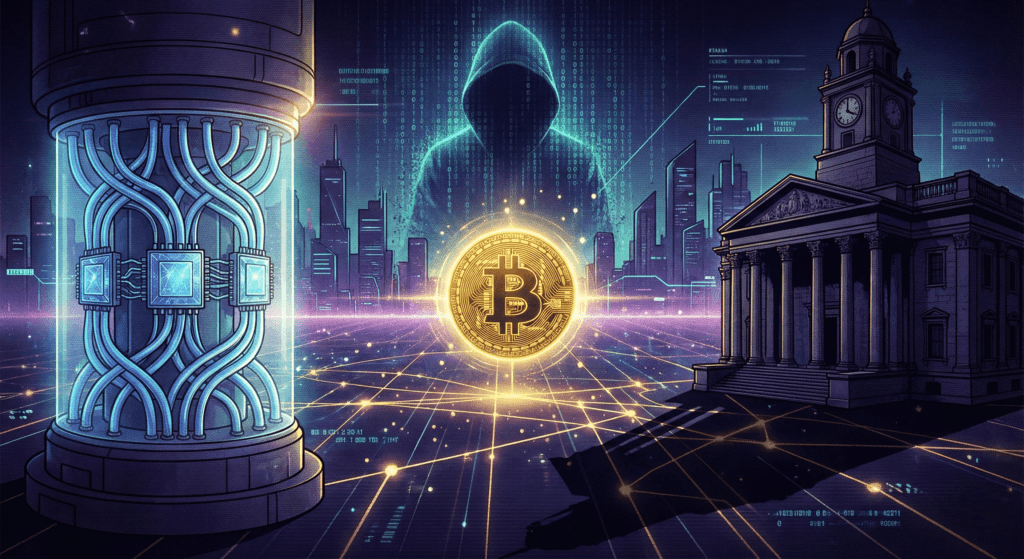
Today, Bitcoin is no longer just a “magic internet money” experiment. It is a geopolitical asset, a hedge against inflation, and a battleground for Wall Street giants. But as Bitcoin matures, it faces two existential threats: Quantum Computers (which could break its code) and Institutional Capture (which could break its spirit).
Here is the story of Bitcoin’s past, present, and dangerous future
Part 1: Who is Satoshi Nakamoto? (The Origin Story)
The brilliance of Satoshi Nakamoto wasn’t just the code; it was their disappearance. By remaining anonymous, Satoshi ensured that Bitcoin had no leader to arrest, no CEO to pressure, and no central point of failure.
The Leading Theories
Despite sleuths and journalists digging for 15 years, the identity remains unconfirmed. Here are the most credible theories as of 2024-2025:
- Hal Finney: A legendary cryptographer who received the first-ever Bitcoin transaction from Satoshi. He lived just blocks away from a man named “Dorian Satoshi Nakamoto” (a likely coincidence Satoshi used as a pseudonym). Finney died in 2014, taking his secrets to the grave.
- Len Sassaman: A privacy advocate and genius cryptographer who tragically took his own life in July 2011, exactly two months after Satoshi’s final communication. Recent theories suggest Sassaman is a strong candidate due to his expertise and the timing of his death.
- The “Group” Theory: The whitepaper uses the pronouns “we” and “I” interchangeably. Some believe Satoshi was a team of experts (possibly including Finney, Nick Szabo, and Adam Back).
- Peter Todd: In an October 2024 HBO documentary, Money Electric: The Bitcoin Mystery, the filmmaker claimed developer Peter Todd was Satoshi. Todd has vehemently denied this, and the evidence was largely circumstantial.
The Verdict: It doesn’t matter. If Satoshi were known, they would be a point of weakness. As a ghost, they are an incorruptible symbol.
Part 2: The Economic “Magic” (Why It Matters)
Satoshi created Bitcoin to answer a specific problem: Corruption in the traditional fiat system.
In the normal economy, Central Banks can print money at will, devaluing your savings (inflation). Governments can freeze the bank accounts of protesters or political rivals. Bitcoin fixes this through Decentralization:
- Immutable Ledger: No one can edit the history.
- Capped Supply: There will never be more than 21 million BTC. This makes it the hardest money in existence digital gold.
- Permissionless: You don’t need a bank’s permission to send value.
This brilliance has forced the world to pay attention. In regions with hyperinflation (like Venezuela or Turkey) or corrupt regimes, Bitcoin has become a literal lifeline for preserving wealth.
Investor Tool : Bitcoin has been the best-performing asset of the decade. Check your potential returns with our free Bitcoin ROI calculator.
Part 3: The Quantum Threat (The Tech Danger And The Future Of Bitcoin)
You may have heard the rumor: “Quantum computers will crack Bitcoin.“ Is this true? Yes, but with a major catch that impacts the future of Bitcoin security
The Problem
Bitcoin is secured by a cryptographic method called Elliptic Curve Cryptography (ECC). Current supercomputers would take millions of years to guess your private key. However, a sufficiently powerful Quantum Computer running “Shor’s Algorithm” could theoretically crack this code in hours.
The Reality Check
- Timeline: Experts estimate we are still 10-15 years away from a quantum computer powerful enough to break Bitcoin (likely between 2035-2040).
- The Vulnerability: About one-third of all Bitcoin (mostly the old coins mined by Satoshi and early adopters) is held in “Pay-to-Public-Key” (p2pk) addresses, which are more vulnerable to quantum attacks.
- The Solution: Bitcoin can be upgraded. Developers are already working on “Post-Quantum Cryptography” (PQC) updates. When the threat gets close, the network can “soft fork” to a new, quantum-resistant encryption method.
The Real Danger: It’s not the tech; it’s the coordination. Getting the whole network to agree on a complex upgrade before the attack happens will be a messy political battle, but it is survivable.
Part 4: The Institutional Takeover (The Corporate Danger)
The other threat isn’t code – it’s money.
As of 2025, huge institutions like BlackRock and Fidelity have moved aggressively into Bitcoin.
- 86% of institutional investors now have exposure to digital assets or plan to in 2025.
- Spot ETFs (Exchange Traded Funds) have sucked up billions of dollars worth of Bitcoin, putting vast amounts of coins into the custody of regulated US corporations.
Will Wall Street Kill Bitcoin?
There is a fear that if institutions own a majority of the coins, they could try to “tame” Bitcoin forcing censorship on transactions or pushing for changes to the protocol that favor governments.
However, Bitcoin has a defense: Institutions own the coins, but they don’t control the nodes. The “rules” of Bitcoin are enforced by tens of thousands of independent computers run by regular people globally. Even if BlackRock owns 10% of the supply, they cannot change the code unless the thousands of node runners agree.
The Future: Bitcoin is diverging into two paths:
- “Sovereign Bitcoin”: Coins held in private wallets (self-custody), which remain uncensorable and truly decentralized.
- “Paper Bitcoin”: Wall Street ETFs that are easy to buy but easy to seize/censor.
Conclusion: The Future of Bitcoin and Its Survival
Bitcoin has died a thousand deaths in the media, yet it keeps surviving. It is unlikely to “fall and fail” in the traditional sense. The real risk is not death, but dilution of its ethos.
If users get lazy and leave their coins on exchanges, Bitcoin becomes just another asset for the corrupt institutions to play with. But if the culture of self-custody and decentralization survives, the future of Bitcoin will remain exactly what Satoshi intended: a magic, unstoppable money for the free world.