
The Roller-Coaster Market
Bitcoin’s value is renowned for its roller-coaster movements. Bitcoin price fluctuations characteristic presents both significant opportunity and considerable risk.
However, understanding the factors behind these real-time Bitcoin rates is crucial for anyone looking to enter the market. Furthermore, it is essential for those wanting to effectively compare crypto prices or invest for the long term.
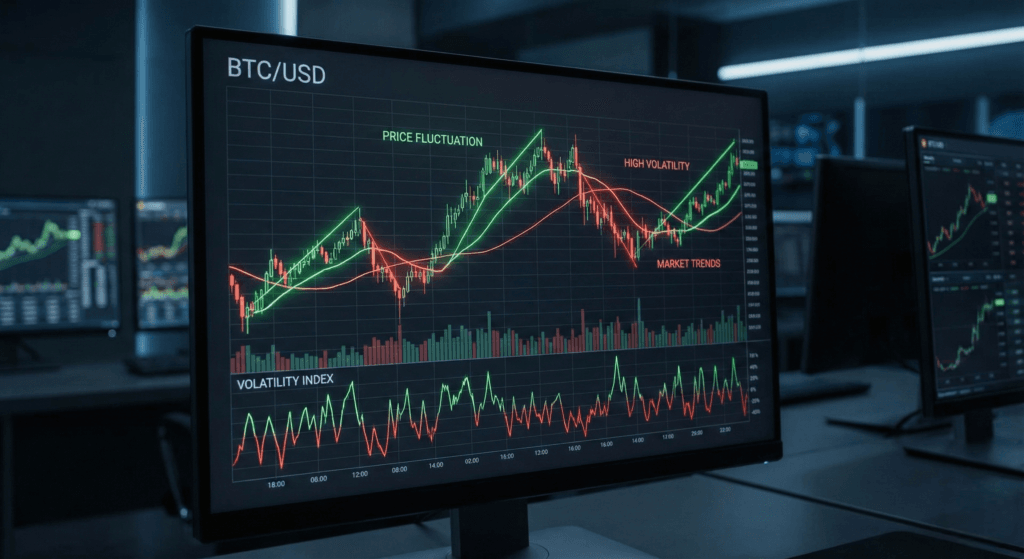
The Mechanics of Volatility
Here is a breakdown of why Bitcoin price fluctuate and what drives the market’s volatility. Key Drivers of Bitcoin Price Volatility: A complex interplay of supply and demand influences Bitcoin prices. Market sentiment, regulatory news, and global economic factors also play a huge role. You can analyze past volatility and see how it affected returns using our Historical Crypto ROI Calculator. And further this will help you to set and ride your future wealth goal using our calculator ”wealth goal” section.
1. Supply and Demand Dynamics
Like any asset, the fundamental principles of supply and demand are the primary drivers of Bitcoin’s price.
- Fixed Supply: Bitcoin has a finite supply, capped at 21 million coins as mentioned in Bitcoin’s whitepaper. As more people want a piece of this limited resource, the demand increases. Consequently, this pushes the price up.
- The Halving Effect: Approximately every four years, the reward that miners receive is cut in half. This “halving” reduces the rate at which new Bitcoins enter circulation. As a result, supply decreases, historically leading to price appreciation due to scarcity.
2. Market Sentiment and News
Human emotion and hype heavily influence the cryptocurrency market which leads to Bitcoin price fluctuations.
- Fear of Missing Out (FOMO): Positive news can trigger a rapid influx of buyers. For example, a major financial institution adopting Bitcoin often causes sharp price surges.
- Fear, Uncertainty, and Doubt (FUD): Conversely, negative news like security breaches or bans can induce panic selling. This often leads to sudden price crashes.
- Media Coverage: News headlines often dictate short-term price movements. A simple report can send prices soaring or plummeting within hours.
3. Regulatory Developments
Governments worldwide are still grappling with how to regulate Bitcoin. Clear, favorable regulations can boost investor confidence.
On the other hand, restrictive measures or outright bans can cause significant drops. Therefore, uncertainty around regulation is a constant source of volatility.
4. Macroeconomic Factors
As Bitcoin matures, its price is increasingly linked to global economic conditions.
- Inflation Hedges: Many view Bitcoin as “digital gold,” a hedge against inflation. Thus, during times of economic instability (such as in 2021 and 2022), investor interest often increases.
- Geopolitical Events: Wars and global crises often see investors moving capital. They move funds into decentralized assets perceived as being outside the traditional financial system.
5. Technological Advances
Improvements in Bitcoin’s technology drive adoption. For instance, the Lightning Network speeds up transactions.
Furthermore, the entry of major institutional players (like BlackRock launching ETFs) drives price increases. Increased adoption solidifies Bitcoin’s position as a legitimate asset class.
Managing Fluctuations with Price Comparison Tools
Navigating these fluctuations effectively requires the right tools. Websites that compare crypto prices are essential for staying ahead. A reliable Bitcoin price comparison tool helps you:
- Track Live Rates: Monitor the live crypto exchange rates across different exchanges in real-time. This allows you to identify the most accurate market price.
- Find the Best Deals: Identify the best platform to buy bitcoin instantly at the lowest price during market dips.
- Make Informed Decisions: Gain a broader view of the market without jumping between multiple websites. Consequently, you make data-driven decisions during volatile periods.
Conclusion
Understanding these drivers empowers you to move beyond simply reacting to price changes. By doing so, you can use the right resources to better navigate the dynamic landscape of Bitcoin investing.