
If you’ve ever looked at a cryptocurrency exchange and noticed two different prices for the same coin one for buying and one for selling you’ve encountered the “Crypto Spread.” While it might look like a minor technical detail, the spread is actually the secret sauce behind one of the most popular low-risk trading strategies in the world: Arbitrage. In this guide, we’ll break down exactly what a spread is, why it matters for your profit margins, and how to measure your long-term success against traditional powerhouses like Gold and the S&P 500.
- The Bid: The maximum price a buyer is willing to pay.
- The Ask: The minimum price a seller is willing to accept.
The difference between these two is the Spread. In the fast-moving world of 2026 crypto markets, these spreads are constantly shifting. A “tight” spread usually means the coin is being traded heavily (high liquidity), while a “wide” spread often signals a unique opportunity or a lack of sellers.
Turning Crypto Spreads into Profit: The Power of Arbitrage
Because the crypto market is fragmented across hundreds of different exchanges (like Binance, Pionex, and KuCoin), the “global price” of Bitcoin or Ethereum isn’t always identical everywhere.
One exchange might have a massive “Ask” price because of a sudden surge in buyers, while another exchange stays lower. This creates a Cross-Exchange Spread.
The Strategy: By buying a coin on an exchange where the price is low and simultaneously selling it where the price is high, you capture the spread as pure profit. This is known as Arbitrage.
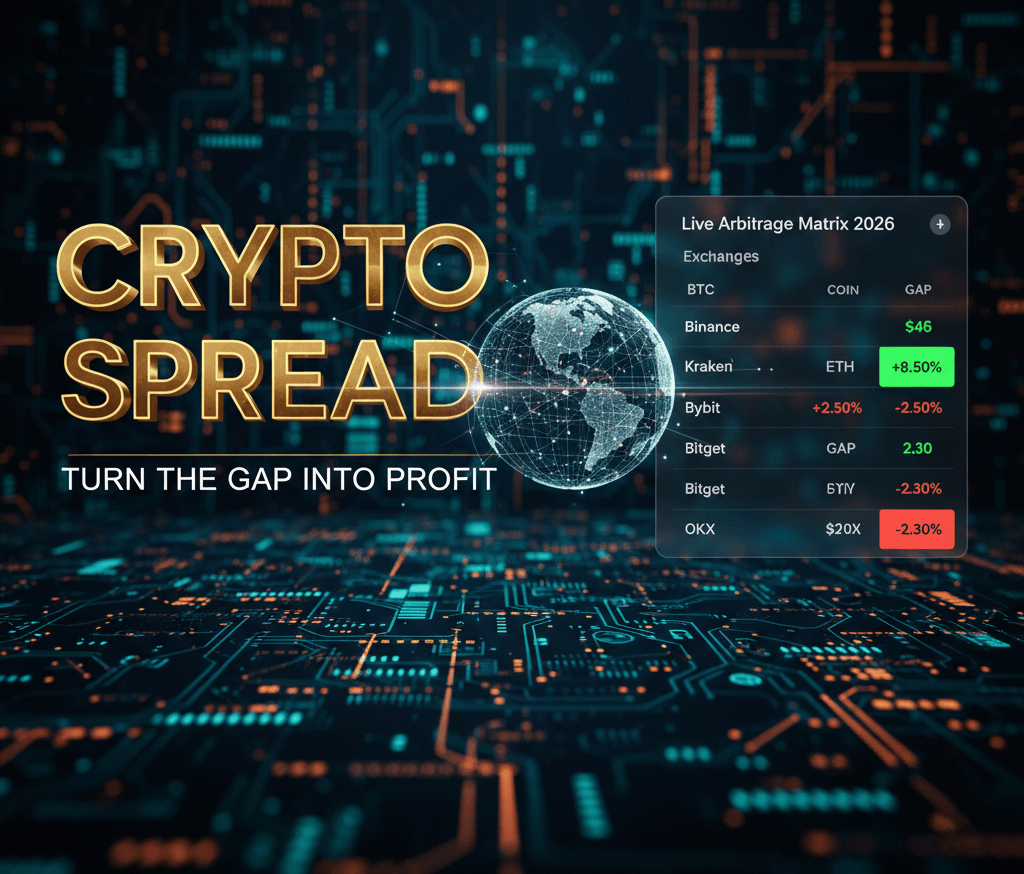
Pro Tip: Hunting for these gaps manually is nearly impossible. Professional traders use tools like our Crypto Arbitrage Matrix to scan 21+ exchanges instantly, highlighting the biggest spreads the moment they appear.
Beyond the Trade: Is Your Profit Actually “Winning”?
Finding a 1% or 2% spread is a great win, but professional investors look at the bigger picture. If your crypto portfolio is growing, you need to know if you are actually outperforming the market or just riding a wave.
To understand your true success, you must compare your ROI (Return on Investment) against the world’s most trusted benchmarks:
Crypto vs. Gold
Gold has been the ultimate “Safe Haven” for centuries. In 2026, many investors view Bitcoin as “Digital Gold.” Using an Ethereum ROI Calculator or Bitcoin tracker allows you to see if your digital assets are actually protecting your wealth better than physical bullion.
Crypto vs. The S&P 500
The S&P 500 (the 500 largest companies in the US) is the standard for stock market success. If your arbitrage and trading profits aren’t beating the 10% historical average of the S&P 500, you might be taking more risk for less reward. Our calculators allow you to overlay your crypto growth directly against stock market performance.
The Silent Wealth Killer: Inflation
A mistake many new traders make is celebrating a “10% profit” without realizing that the cost of living (inflation) rose by 5% in that same year. Your “Real Return” is only 5%.
In an era of fluctuating global economies, inflation adjustment is non-negotiable. When you use our suite of Investment Calculators, you have the power to:
- Toggle Inflation Adjustment: See the “Real Value” of your profits in today’s purchasing power.
Summary: Your 3-Step Success Plan
Mastering the crypto markets in 2026 requires two things: identifying immediate opportunities and tracking long-term health.
- Step 1: Use the Crypto Arbitrage Matrix to find and capture live spreads across exchanges.
- Step 2: Move your profits into long-term holdings.
- Step 3: Use our ROI Calculators to ensure your crypto is outperforming Gold and the S&P 500 while staying ahead of inflation.
Ready to see the gaps? Check the Live Arbitrage Matrix now to see which exchanges are offering the best spreads this minute.