
The battle lines for the future of the American dollar are being drawn by the Genius Act. In a high-stakes White House roundtable on February 10, 2026, a group of the nation’s most powerful banking CEOs met with the President’s crypto adviser, Patrick Witt, with a singular mission: to kill the stablecoin “reward” programs that have been draining their deposits for months.
At the heart of this conflict is the Genius Act (Guiding and Establishing National Innovation for U.S. Stablecoins). While this legislation was hailed as a landmark for regulatory clarity in 2025, it has sparked a fierce “Deposit War” that will reach its breaking point on the March 1st, 2026 deadline.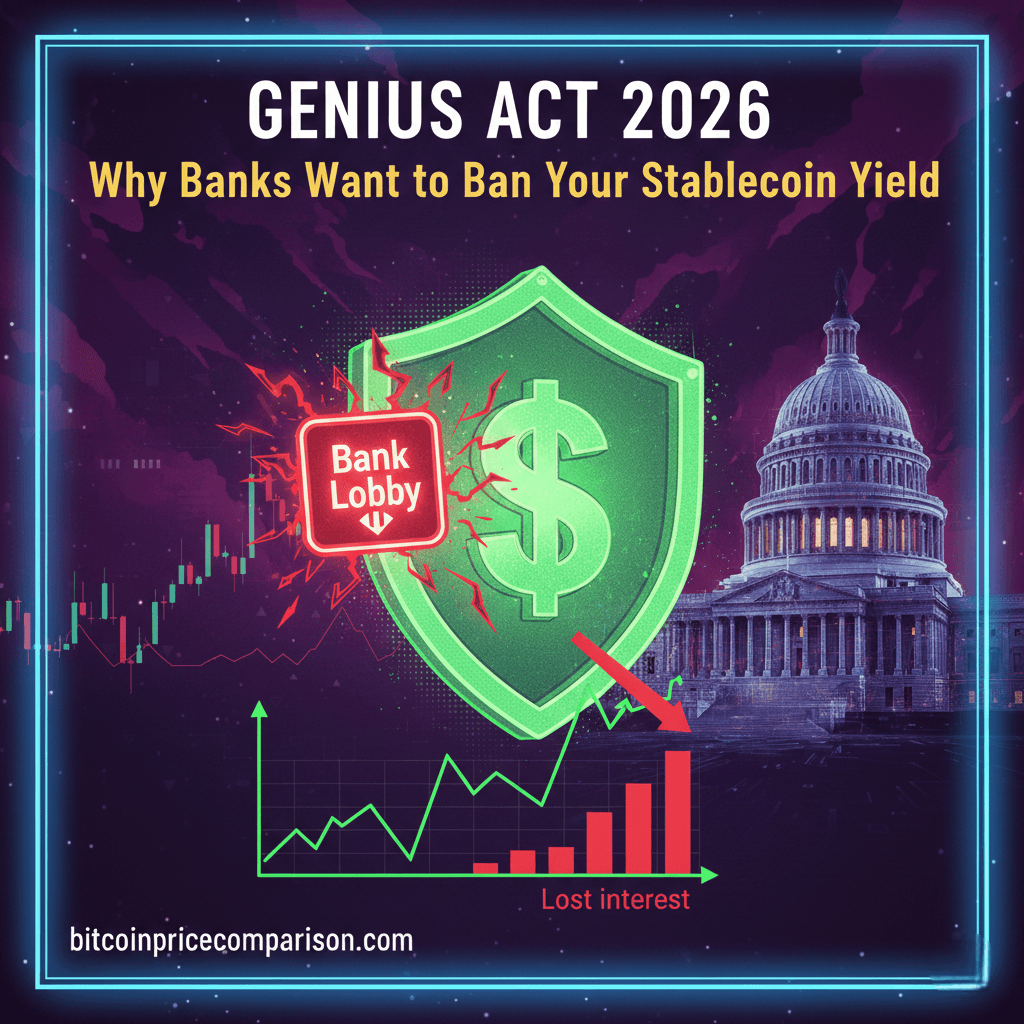 The Genius Act 2026 standoff: Will the bank lobby succeed in banning stablecoin rewards?
What is the GENIUS Act “Interest Ban”?
To understand the current crisis, you have to look at the fine print of the law. The GENIUS Act was designed to treat stablecoins as a payment tool, not an investment. To ensure this, Section 16(d) explicitly prohibits stablecoin issuers from paying “interest or yield” to holders.
The logic was simple: if a digital dollar doesn’t pay interest, it won’t compete with a traditional bank savings account. However, the law left a massive opening that the crypto industry was quick to fill the Affiliate Reward Loophole.
The Loophole That Terrifies Wall Street
While the issuers (like Circle or Paxos) don’t pay interest, the exchanges and distribution partners do. By rebranding interest as “loyalty rewards” or “platform incentives,” exchanges have managed to offer yields ranging from 3.5% to 5.2% in early 2026.
The American Bankers Association (ABA) recently issued a blistering letter to Congress, claiming these rewards are a “semantic fiction” designed to circumvent the law. Their fear is grounded in math: as of February 2026, over $1.2 trillion has migrated from traditional low-yield savings accounts into reward-bearing stablecoins.
Banks vs. Stablecoins: The Real ROI Gap
Why are users moving their money? It’s a matter of survival in an inflationary economy. Even with 2026 inflation cooling to 2.4%, a traditional bank account paying 0.05% is effectively a “wealth tax.” You are losing purchasing power every single day your money sits in a legacy vault.
In contrast, stablecoin rewards are backed by the same high-quality liquid assets (HQLA) that banks use primarily short-term U.S. Treasuries. The difference is that crypto platforms are passing more of that yield back to the user, while banks are keeping the spread to fund their massive overhead.
Don’t Let the Banks Win the Math Game: Before the rules change, use our ROI Calculator to see the actual dollar difference between your bank account and a stablecoin reward program.
The “Inflation Trap”: A Visual Comparison
When you look at your balance, it might look like it’s growing. But professional investors look at “Real Returns.” If your bank pays you $10 in interest, but the cost of groceries goes up by $50, you haven’t made a profit you’ve lost $40. Stablecoin rewards at 4% allow your cash to actually “outrun” inflation, a fact the banking lobby is desperate to hide from the general public.
Pro Tip: Toggle the Inflation Adjustment on our benchmark Crypto ROI Calculator to see your true purchasing power. You’ll quickly realize why Wall Street is lobbying so hard for a “Total Yield Ban.”
Patrick Witt’s Deadline: What Happens on March 1st?
The White House has issued a “compromise or else” directive. If the crypto industry and the banking sector cannot agree on a definition of “permissible rewards” by March 1, 2026, the administration may back a legislative amendment to close the loophole entirely.
- The “Banker’s Dream” Scenario: All forms of financial consideration for holding stablecoins are banned. Yields go to zero, and money flows back to banks.
- The “Innovation” Scenario: Rewards remain legal, but only for “active” users who use stablecoins for payments, rather than just “parking” cash.
Conclusion: The New Era of the Digital Dollar
The GENIUS Act standoff is about more than just a few percentage points of interest; it’s about who controls the flow of capital in the 21st century. If the banks succeed in banning rewards, the “Digital Dollar” becomes nothing more than a high-tech version of a checking account.
If the “reward” model survives, it represents a fundamental shift in how the average person interacts with their money turning “passive cash” into an active, yielding asset that resists the hidden tax of inflation.
The clock is ticking. As the March 1st deadline approaches, ensure your portfolio is positioned for the shift.