
Bitcoin’s self-custody revolution gave users financial sovereignty but it also introduced a critical responsibility: safeguarding private keys. For years, the 12- or 24-word seed phrase has been the foundation of Bitcoin wallet security. But as adoption grows and capital inflows increase, the limitations of seed phrase–based security are becoming more visible. For intermediate investors holding meaningful BTC positions, one question is emerging: Is the seed phrase model still enough?
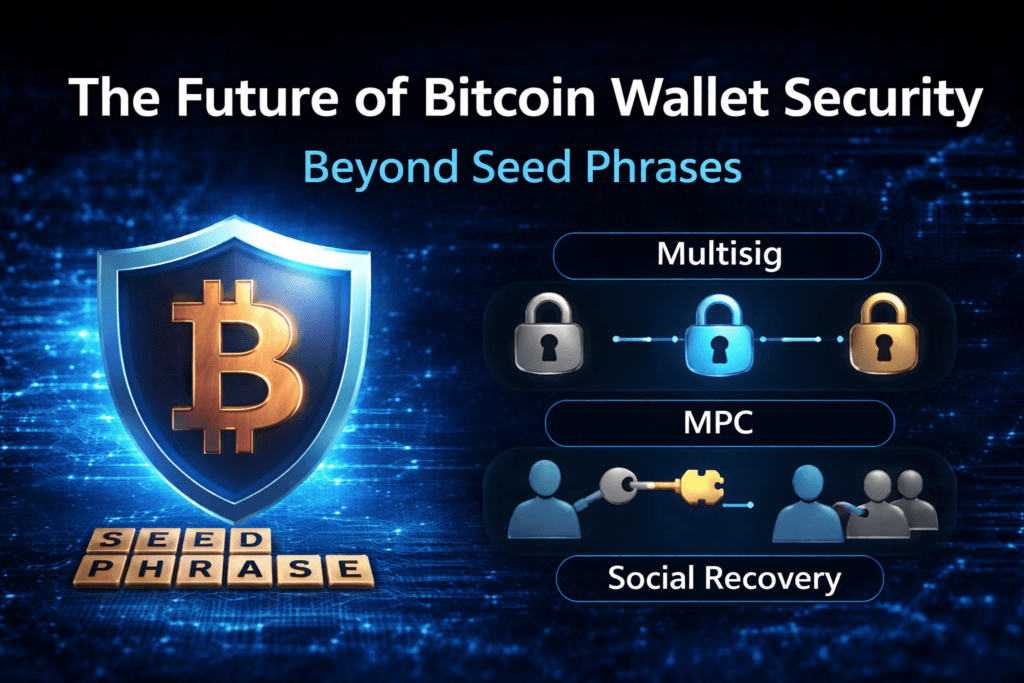
1️⃣ The Seed Phrase Model: Strengths and Weaknesses
The seed phrase system, based on BIP-39 standards, brought portability and recoverability to Bitcoin wallets. It allows:
- Full self-custody
- Wallet recovery across devices
- Standardized backup processes
However, it also introduces key vulnerabilities:
- Single point of failure
- Physical theft risk
- Human error (loss, misplacement, improper storage)
- Social engineering exposure
If someone gains access to your seed phrase, your Bitcoin is gone permanently. As Bitcoin becomes a macro asset and institutional-grade investment, relying on a single secret backup is increasingly seen as fragile.
2️⃣ Multisignature Wallets: Distributed Trust
Multisignature (multisig) wallets require multiple private keys to authorize a transaction for example, 2-of-3 or 3-of-5 configurations. Instead of one seed phrase controlling everything, control is distributed across multiple devices or parties.
Why multisig is gaining traction:
- Eliminates single point of failure
- Protects against device compromise
- Reduces physical theft risk
- Enables shared custody structures
This is why institutional custodians and serious long-term holders increasingly adopt multisig frameworks. For intermediate investors holding significant BTC, multisig represents a meaningful upgrade over basic hardware wallet storage.
3️⃣ Multi-Party Computation (MPC): Seedless Security
MPC (Multi-Party Computation) is one of the most promising innovations in wallet security. Instead of generating one private key and backing it up, MPC splits key generation across multiple parties. No single party ever holds the full key.
Advantages include:
- No traditional seed phrase
- Distributed signing
- Reduced risk of key exposure
- Flexible recovery mechanisms
MPC is already being used by institutional custodians and advanced wallet providers. However, it often introduces:
- More complexity
- Partial reliance on service providers
- Different trust assumptions compared to pure self-custody
For intermediate investors, MPC represents a bridge between self-custody and professional-grade security.
4️⃣ Social Recovery: Human-Based Redundancy
Another evolving concept is social recovery. Instead of writing down a seed phrase, users designate trusted guardians who can help restore wallet access if keys are lost. This model:
- Reduces the burden of physical backups
- Protects against loss
- Maintains decentralized recovery
While more common in Ethereum-based wallets, similar concepts are influencing Bitcoin wallet design discussions. The challenge is balancing:
- Trust
- Privacy
- Simplicity
As user experience improves, social recovery could significantly reduce lost Bitcoin incidents.
5️⃣ Hardware Wallet Evolution
Hardware wallets were the first major upgrade from software wallets. But even they rely on seed phrases. Future improvements may include:
- Secure enclave integration
- Biometric verification
- Encrypted cloud-assisted backup (without exposing keys)
- Improved anti-phishing protections
The next generation of devices will likely focus on: Reducing user error without sacrificing sovereignty. Because in Bitcoin security, human error is often the weakest link, not cryptography. You can know amore about some of the best available Crypto Wallets available in market.
6️⃣ The Institutional Effect on Wallet Security
As ETFs, corporate treasuries, and sovereign entities accumulate Bitcoin, custody expectations are changing. Security standards now consider:
- Insider threat models
- Jurisdictional risk
- Disaster recovery
- Legal key-sharing frameworks
Retail wallet security will inevitably evolve as institutional practices mature. This creates a powerful shift:
From “store your seed phrase safely” to “Design layered security architecture.”
7️⃣ The Core Debate: Convenience vs Sovereignty
Seed phrases are simple. Multisig is secure but complex. Multisig is secure but complex. The future of Bitcoin wallet security will likely combine:
- Redundancy
- Usability
- Distributed key control
- Human error mitigation
The real innovation won’t be eliminating keys, it will be making key management invisible while preserving sovereignty.
🔮 What Should Intermediate Investors Do Now?
If you hold a small BTC allocation, a reputable hardware wallet with secure seed storage may be sufficient. If your Bitcoin position is meaningful relative to your net worth, you need to consider:
- Multisig setup
- Geographically separated backups
- Shamir backup schemes
- Professional security consultation
Security should scale with portfolio size. Because in Bitcoin, custody is risk management.
📌 Final Thoughts
The seed phrase was revolutionary. But it may not be the final stage of wallet security evolution. As Bitcoin adoption expands and capital deepens, security models must adapt. The future is not about replacing self-custody, it’s about making it resilient, distributed, and human-proof.
Bitcoin’s monetary network is decentralized., so its custody solutions must evolve the same way.