
Governments around the world are exploring new ways to improve transparency, efficiency, and security. This is where blockchain in government is gaining attention. Blockchain is already transforming industries like real estate through tokenization and real-world asset (RWA) integration.
Instead of relying on traditional systems, governments are starting to use blockchain to:
- Reduce corruption
- Improve record-keeping
- Speed up processes
In this guide, you’ll learn how governments are using blockchain technology in simple terms.
 What Is Blockchain (Simple Explanation)
 What Is Blockchain (Simple Explanation)
Blockchain is a ”digital ledger” that records data in a secure and transparent way.
 Key features:
- Decentralized
- Immutable (cannot be changed easily)
- Transparent
This makes it useful for systems where trust and verification are important.
Why Governments Are Interested in Blockchain
 Why Governments Are Interested in Blockchain
Governments deal with:
- Large amounts of data
- Public trust issues
- Complex systems
Blockchain helps solve:
 Fraud & corruption Inefficiency Lack of transparency
These benefits are driving adoption across multiple sectors beyond crypto trading.
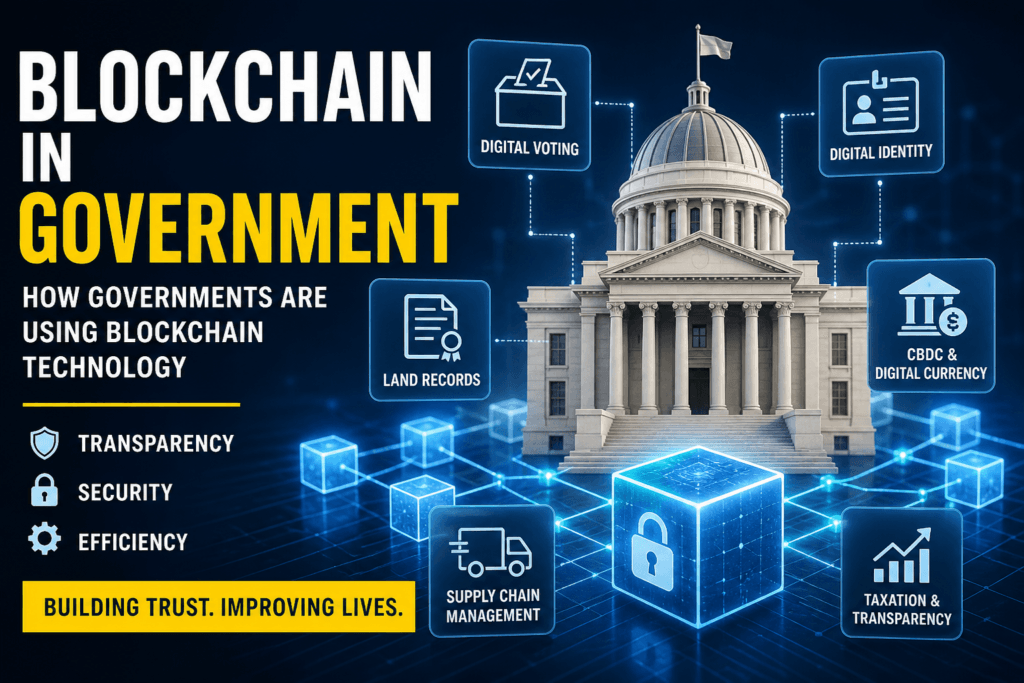
How Governments Are Using Blockchain
 How Governments Are Using Blockchain
 1. Digital Voting Systems
 1. Digital Voting Systems
 Blockchain can make voting:
- Transparent
- Secure
- Tamper-proof
This can reduce election fraud and increase trust.
2. Land and Property Records
 2. Land and Property Records
 Governments are using blockchain to:
- Store land ownership data
- Reduce disputes
- Prevent fraud
This is especially useful in countries with unclear property records.
3. Digital Identity Systems
 3. Digital Identity Systems
 Blockchain can store identity data securely.
Benefits:
- Reduced identity theft
- Easier verification
- Faster access to services
4. Tax Collection and Tracking
 4. Tax Collection and Tracking
 Blockchain helps:
- Track transactions
- Reduce tax evasion
- Improve compliance
5. Supply Chain Management
 5. Supply Chain Management
 Governments use blockchain to track:
- Goods movement
- Imports/exports
- Authenticity of products
6. Central Bank Digital Currencies (CBDCs)
 6. Central Bank Digital Currencies (
 Many governments are developing digital versions of their currency.
Examples:
- Digital Rupee
- Digital Yuan
Benefits:
- Faster payments
- Better control
- Reduced cash dependency
CBDCs represent one of the biggest government-led blockchain initiatives globally.
Real-World Examples
 Real-World Examples
India
Exploring blockchain for:
- Land records
- Digital identity
- CBDC (Digital Rupee)
Estonia
One of the most advanced:
- Digital identity system
- Secure government records
China
Leading in:
- Digital Yuan
- Blockchain-based infrastructure
Countries around the world are experimenting with blockchain to improve governance and efficiency.
Benefits of Blockchain for Governments
 Benefits of Blockchain for Governments
 Increased transparency Reduced corruption Faster services Better data security Cost efficiency
Challenges and Limitations
 Challenges and Limitations
 Regulatory concerns High implementation cost Technical complexity Privacy concerns
Adoption is still evolving. However, like any emerging technology, blockchain adoption comes with risks and uncertainties.
Future of Blockchain in Government
 Future of Blockchain in Government
Blockchain could:
- Transform public services
- Improve governance
- Increase citizen trust
Quick Summary
Governments use blockchain for voting, identity, land records, and CBDCs It improves transparency and efficiency Adoption is growing but still early
Final Thoughts
 Final Thoughts
Blockchain is not just for crypto. It’s becoming a tool for governments to build better systems.
Key Takeaways
- Blockchain in government is used to improve transparency, efficiency, and security in public systems.
- Governments are adopting blockchain for voting, land records, digital identity, and supply chain tracking.
- Central Bank Digital Currencies (CBDCs) are one of the most important blockchain use cases by governments.
- Blockchain helps reduce fraud, corruption, and administrative delays.
- Challenges include regulation, implementation cost, and privacy concerns.
Frequently Asked Questions (FAQ)
1. What is blockchain in government?
Blockchain in government refers to the use of blockchain technology to improve public services, data management, and transparency in government systems.
2. How are governments using blockchain technology?
Governments use blockchain for digital identity, land records, voting systems, supply chain tracking, and central bank digital currencies (CBDCs).
3. What are the benefits of blockchain for governments?
Benefits include improved transparency, reduced corruption, faster processes, better data security, and cost efficiency.
4. Are governments adopting blockchain widely?
Adoption is growing globally, but it is still in early stages in many countries.
5. What are the risks of using blockchain in government?
Risks include regulatory challenges, high implementation costs, technical complexity, and concerns about data privacy.