
RWA in blockchain gaming is evolving fast. Many investors are now exploring newer crypto sectors beyond Bitcoin and traditional altcoins. Earlier, most crypto games focused mainly on:
 Play-to-Earn (P2E) rewards. Players earned tokens by:
 Playing gamesCompleting tasksTrading NFTs
But many of these models struggled because: Rewards became unsustainable Token prices crashed Players focused more on earning than gameplay
Now, a new trend is changing the industry: RWA (Real World Assets)
RWA is helping blockchain gaming move beyond simple play-to-earn systems toward: Real ownership Sustainable economies Utility with real-world value
 What Is RWA in Blockchain Gaming?
 What Is RWA in Blockchain Gaming?
RWA stands for: Real World Assets
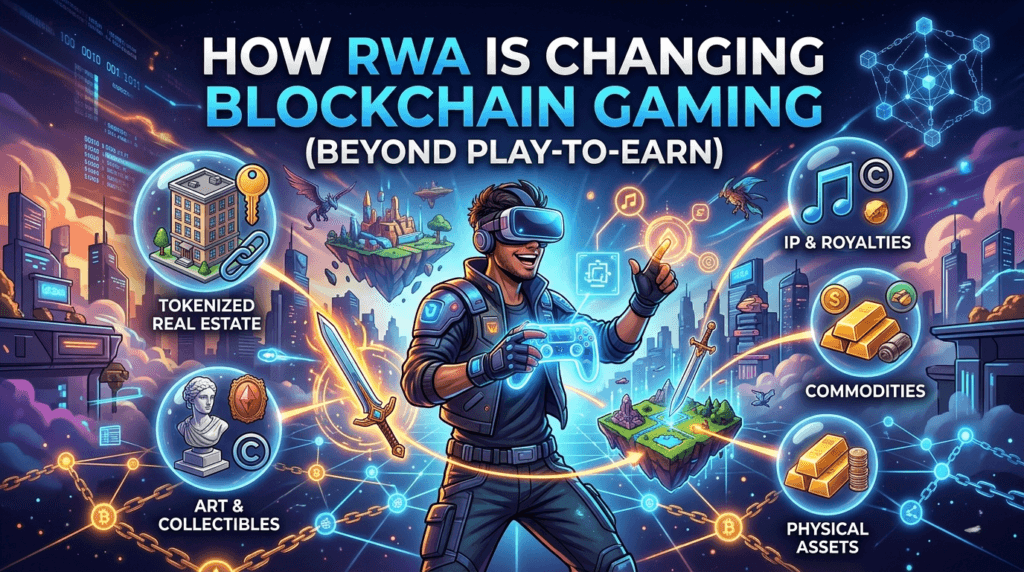
RWA is becoming one of the fastest-growing trends across the broader crypto industry. In crypto, it refers to connecting blockchain assets with real-world value or utility. In gaming, this can include:
- Digital ownership with real value
- Tokenized assets
- NFT items linked to broader ecosystems
- Virtual assets with economic utility outside the game
Instead of earning tokens with no long-term use, players may own assets that have broader value and utility.
Why Traditional Play-to-Earn Struggled
Early blockchain games became extremely popular during the crypto boom. Games like:
helped introduce millions of users to Web3 gaming. But many projects faced problems:
Inflationary rewards Weak gameplay Unsustainable token economies Dependence on new users joining
Many players were focused only on profits rather than the gaming experience. Emotional investing and hype-driven decisions caused many retail users to lose money during earlier crypto gaming cycles.
How RWA Is Changing Blockchain Gaming
 How RWA Is Changing Blockchain Gaming
RWA introduces a more realistic approach. Instead of relying only on reward tokens:
♦️Games are now focusing on: Digital ownership Interoperable assets Utility beyond gaming Long-term ecosystems
This creates more sustainable economies and stronger player engagement. Sustainable digital ownership models may become more important than short-term token rewards.
Blockchains Powering Modern Blockchain Games
 Blockchains Powering Modern Blockchain Games
Several blockchain networks are becoming major gaming ecosystems because of: Low transaction fees Fast speeds NFT support Better scalability
1. Ronin (RON)
 1. Ronin (RON)
Ronin was created by the team behind Axie Infinity and became one of the first major gaming-focused blockchains.
It is known for:
- Fast transactions
- Low fees
- Strong gaming ecosystem
Popular games:
- Axie Infinity
- Pixels
- Apeiron
The RON token is available on several major crypto exchanges (Binance, Kucoin) for retail users. Faster and cheaper blockchains are becoming essential for scalable blockchain gaming ecosystems.
2. Immutable X (IMX)
 2. Immutable X (IMX)
Immutable X focuses heavily on: NFT gaming Gas-free transactions Scalable Web3 gaming
The ecosystem supports:
- NFT marketplaces
- Gaming infrastructure
- Web3 game development
Popular games:
- Gods Unchained
- Illuvium
- Guild of Guardians
The IMX token is widely traded on crypto exchanges. Immutable also partnered with Polygon to expand gaming infrastructure. And NFT scalability remains one of the biggest challenges for blockchain gaming adoption.
3. Polygon (POL)
 3. Polygon (POL)
Polygon became one of the biggest & widely used blockchain ecosystems for gaming & NFT because of:
- Low transaction costs
- Ethereum compatibility
- Large developer ecosystem
Games and gaming projects use Polygon for: NFTs In-game assets Metaverse applications
Popular projects:
- The Sandbox
- Planet IX
- Sunflower Land
Polygon also collaborates with Immutable to support Web3 gaming growth.
4. Avalanche (AVAX)
 4. Avalanche (AVAX)
Avalanche is gaining attention in gaming because of: High speed Subnet technology Custom gaming chains
This allows developers to create optimized gaming environments with better scalability.
5. Solana (SOL)
 5. Solana (SOL)
Solana supports blockchain gaming with:
- High transaction throughput
- Low fees
- Fast confirmation times
Its ecosystem continues growing among gaming and NFT projects.
Gaming Coins Retail Users Can Buy
 Gaming Coins Retail Users Can Buy
Many gaming-related crypto coins are available on popular exchanges. Before buying gaming crypto coins, always compare exchange trading fees, crypto spreads, and platform pricing differences across exchanges. You can also track historical crypto returns and long-term ROI using our Bitcoin & crypto ROI tools. Price difference between exchanges may also create arbitrage opportunities in volatile crypto markets.
 These are examples of gaming-related crypto assets and not investment recommendations.
| Coin | Ecosystem |
|---|---|
| IMX | Immutable X |
| RON | Ronin |
| SAND | The Sandbox |
| MANA | Decentraland |
| ILV | Illuvium |
| AVAX | Avalanche |
| POL | Polygon |
| SOL | Solana |
Beyond Play-to-Earn: The New Direction
 Beyond Play-to-Earn: The New Direction
The future of blockchain gaming may focus more on: Ownership Utility Interoperability Sustainable economies
Instead of: Unsustainable token rewards Pure speculation
The industry is slowly shifting from “earn quick money” toward building real digital economies. And the focus is slowly shifting from speculation toward utility and sustainable ecosystems.
Why This Matters for Gamers
Players may benefit from: Better ownership of assets Transferable digital items More valuable gaming ecosystems Better long-term sustainability
Risks Still Exist
Even with RWA growth, blockchain gaming still carries risks. Hence, always research projects before investing money.
Token volatility Scams and fake projects Regulatory uncertainty Game failures
Beginners should always research projects carefully before investing in gaming-related crypto assets to avoid scams.
Smart Approach for Beginners
 Smart Approach for Beginners
If you’re exploring blockchain gaming, treat gaming coins as high-risk crypto assets.
Focus on gameplay first Avoid hype-driven decisions Understand token utility Use proper risk management
Fear and greed continue to influence investment decisions in both gaming coins and the broader crypto market.
Final Thoughts
Blockchain gaming is changing rapidly. RWA is helping move the industry beyond basic play-to-earn systems toward more sustainable digital ownership models. Blockchains like:
- Ronin
- Immutable X
- Polygon
- Avalanche
- Solana
are helping shape the next generation of Web3 gaming ecosystems.
The future may not be just: “Play to earn” But instead: “Play to own and participate in digital economies.”
Key Takeaways
- RWA in blockchain gaming is helping create more sustainable gaming ecosystems beyond traditional play-to-earn models.
- Modern blockchain games are focusing more on digital ownership, utility, and long-term value.
- Gaming blockchains like Ronin, Immutable X, Polygon, Avalanche, and Solana are supporting Web3 gaming growth.
- Gaming crypto coins such as IMX, RON, SAND, MANA, and ILV are available on several crypto exchanges for retail users.
- Blockchain gaming still carries risks, including volatility, scams, and unsustainable token economies.
Frequently Asked Questions (FAQ)
1. What is RWA in blockchain gaming?
RWA in blockchain gaming refers to integrating real-world asset concepts and utility into gaming ecosystems to create more sustainable digital economies.
2. How is RWA changing blockchain gaming?
RWA is shifting blockchain gaming beyond simple play-to-earn rewards toward digital ownership, utility, and long-term ecosystem value.
3. Which blockchains support blockchain games?
Popular gaming blockchains include Ronin, Immutable X, Polygon, Avalanche, and Solana due to their scalability and low transaction fees.
4. What are some popular blockchain gaming coins?
Examples include IMX, RON, SAND, MANA, ILV, AVAX, POL, and SOL.
5. Is blockchain gaming risky?
Yes, blockchain gaming involves risks such as token volatility, scams, project failures, and changing market conditions.