
Digital currencies are becoming more popular worldwide. Governments, banks, and crypto investors are all paying attention and more & more talking about CBDCs vs Bitcoin along with the growing use of blockchain technology. Many beginners are now trying to understand how traditional finance and cryptocurrencies may co-exist in the future.
But many beginners get confused:  Are CBDCs the same as Bitcoin?
The answer is:  No.
No.
Even though both are digital currencies, they are built for completely different purposes.
In this guide, you’ll learn: What Market discussions about CBDCs vs Bitcoin How Bitcoin works The biggest differences between them Why this matters for the future of money
 What Are CBDCs?
 What Are CBDCs?
CBDC stands for: Central Bank Digital Currency
A CBDC is a digital version of a country’s traditional currency issued and controlled by the central bank. However, CBDCs are very different from decentralized cryptocurrencies like Bitcoin.
Examples:
- Digital Dollar (USA – proposed)
- Digital Euro
- Digital Yuan (China)
- Digital Rupee
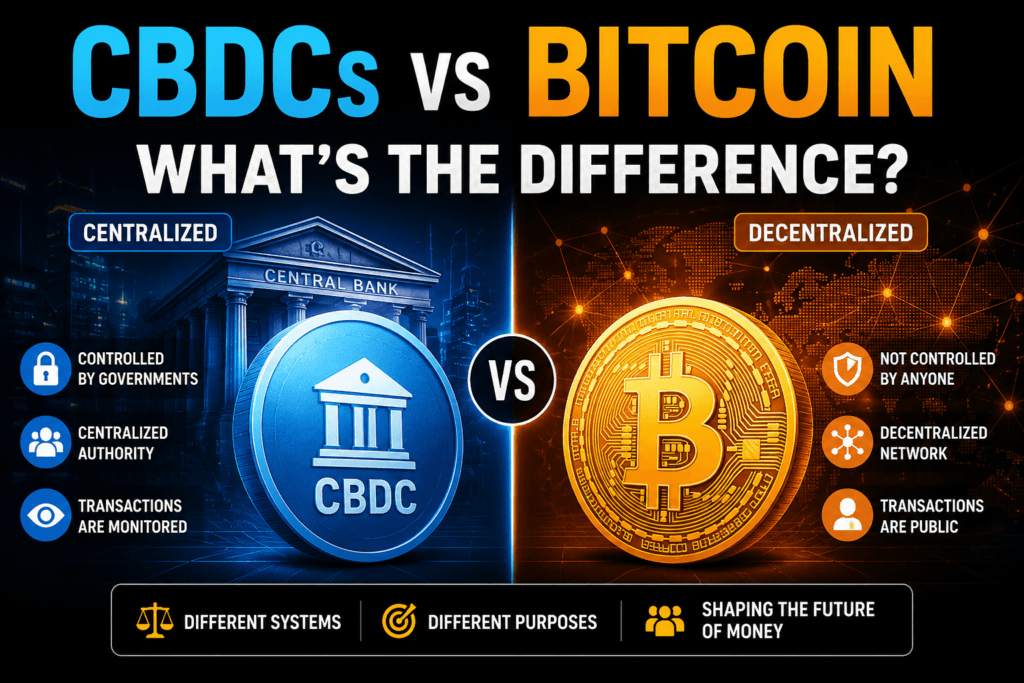
Unlike cryptocurrencies, CBDCs are centralized: Governments control them Central banks manage supply and transactions
₿ What Is Bitcoin?
Bitcoin is the world’s first decentralized cryptocurrency. Many investors also view Bitcoin as a long-term store of value because of its limited supply.
It was created in 2008 with a cap of 21 million bitcoins to allow: Peer-to-peer payments Decentralized ownership Financial independence without banks
Unlike CBDCs: Bitcoin is not controlled by any government or central authority.
Instead: It runs on blockchain technology Transactions are verified by a decentralized network
CBDCs vs Bitcoin: Key Differences
 CBDCs vs Bitcoin: Key Differences
| Feature | CBDCs | Bitcoin |
|---|---|---|
| Control | Centralized | Decentralized |
| Issued By | Central banks | Network protocol |
| Supply | Controlled by governments | Limited to 21 million |
| Privacy | Lower | Higher (relative) |
| Transactions | Government monitored | Public blockchain |
| Purpose | Digital fiat currency | Alternative decentralized money |
Why Governments Want CBDCs
 Why Governments Want CBDCs
Governments are exploring CBDCs because they may offer:
Faster payments Lower transaction costs Better financial tracking Reduced cash dependency
CBDCs may also help central banks modernize payment systems. Governments worldwide are increasingly exploring blockchain-based financial infrastructure.
Concerns About CBDCs
 Concerns About CBDCs
Critics argue that CBDCs could increase government control over financial activity. Some people are also concerned about CBDCs because of:
Privacy risks Centralized control Transaction monitoring Potential restrictions on spending
Why Bitcoin Is Different
 Why Bitcoin Is Different
Bitcoin was designed to solve a different problem.
Its goals include: Decentralization Limited supply Resistance to censorship Financial sovereignty
Many investors view Bitcoin as “Digital gold” because of its limited supply and independence from governments.
Can CBDCs Replace Bitcoin?
 Can CBDCs Replace Bitcoin?
Probably not as CBDCs and Bitcoin serve different purposes. However, the future of finance may include a mix of centralized & decentralized digital assets. CBDCs aim to modernize traditional finance. Bitcoin aims to provide decentralized digital money.
Why This Matters for Investors
Understanding the difference helps investors:
Understand risk Understand regulation Avoid confusion Make better long-term decisions
Risks to Understand
CBDC Risks
- Privacy concerns
- Government control
- Regulatory uncertainty
Bitcoin Risks
- Price volatility
- Regulatory changes
- Market speculation
Beginners or even veteran investors should always understand risks before investing in highly volatile crypto assets. This can prevent from having unnecessary loses or getting trapped in any crypto scam.
Simple Example
 Simple Example
 CBDCs are like: A digital version of your normal bank money controlled by the government.
Bitcoin is like: A decentralized digital asset that operates independently of banks.
The Future of Digital Money
 The Future of Digital Money
As digital finance is evolving quickly, the future may include: CBDCs for regulated payments Bitcoin for decentralized value storage Stablecoins for crypto transactions
Final Thoughts
 Final Thoughts
CBDCs and Bitcoin are often compared, but they are fundamentally different. Understanding these differences is important as digital currencies continue growing worldwide.
CBDCs focus on: Control Regulation Efficiency
Bitcoin focuses on: Decentralization Scarcity Financial independence
Key Takeaways
- CBDCs and Bitcoin are both digital currencies, but they are designed for different purposes.
- CBDCs are centralized and controlled by governments or central banks.
- Bitcoin is decentralized and operates independently of banks and governments.
- CBDCs focus on efficiency and regulation, while Bitcoin focuses on decentralization and scarcity.
- Both CBDCs and Bitcoin may coexist as digital finance continues evolving worldwide.
Frequently Asked Questions (FAQ)
1. What is the difference between CBDCs and Bitcoin?
CBDCs are centralized digital currencies controlled by governments, while Bitcoin is a decentralized cryptocurrency that operates independently of central banks.
2. What does CBDC stand for?
CBDC stands for Central Bank Digital Currency, which is a digital form of traditional government-issued money.
3. Is Bitcoin a CBDC?
No, Bitcoin is not a CBDC. Bitcoin is decentralized and not controlled by any government or central authority.
4. Why are governments creating CBDCs?
Governments are exploring CBDCs to improve payment systems, reduce transaction costs, and modernize financial infrastructure.
5. Can CBDCs replace Bitcoin?
Most experts believe CBDCs and Bitcoin serve different purposes and may coexist rather than replace each other.