
The Lump Sum vs Dollar Cost Averaging debate is the most paralyzing question in crypto. It isn’t just about “what to buy” it’s “when to buy.”
We have all heard the horror stories. Someone buys Bitcoin when it’s trending, only to watch the price crash 50% the next month. This fear of “buying the top” keeps millions of potential investors on the sidelines, holding cash while inflation eats away at their savings.
But what if you didn’t have to time the market perfectly?
There are two main ways to enter the market: Lump Sum (throwing all your money in at once) and Dollar Cost Averaging (investing smaller amounts consistently).
We used our historical ROI calculator to test the “worst-case scenario”starting your investment at the absolute peak of the market to see which strategy actually protects your money.
The Lump Sum vs Dollar Cost Averaging Experiment
Let’s imagine it is November 2021. Bitcoin has just hit its all-time high of $69,000. The hype is everywhere.
- Investor A (Lump Sum) feels the FOMO. He takes his entire $20,000 savings and buys Bitcoin right at the top.
- Investor B (DCA) is cautious. He decides to invest that same money slowly $100 every month starting on that same peak day.
What happened next?
The market crashed. For the next year, Bitcoin plummeted, bottoming out around $16,000.
- Investor A was devastated. He watched his portfolio shrink by 75%. He spent years just praying to break even.
- Investor B had a completely different experience. Because he was buying monthly, he bought more Bitcoin when it was cheap ($16k, $20k). He lowered his “average cost” automatically.
The Results: How DCA Saved the Portfolio
Here is the actual data from our Bitcoin ROI Calculator, simulating that exact DCA strategy starting from the 2021 peak:
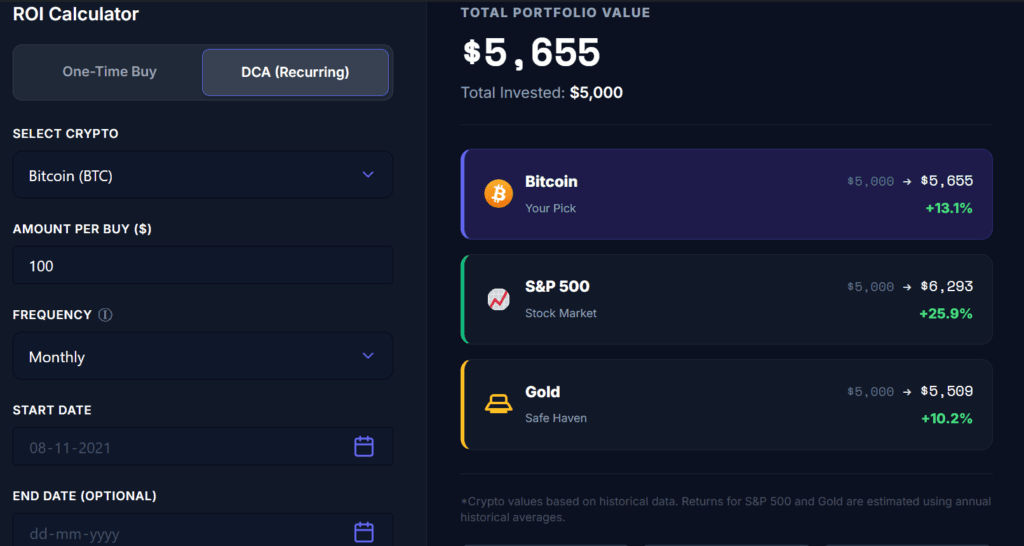
As you can see, even though Investor B started at the worst possible time, their portfolio recovered much faster. While the Lump Sum investor was still underwater waiting for the price to return to $69,000, the DCA investor was already in profit long before that.
Why DCA Works (The Math)
Dollar Cost Averaging isn’t magic; it’s simple math.
When you commit to buying $100 monthly, you are following a strict rule:
- When prices are high: Your $100 buys fewer coins.
- When prices are low: Your $100 buys more coins.
You naturally accumulate the bulk of your stack when the asset is “on sale.” This smooths out the volatility curve. Instead of a rollercoaster ride that depends entirely on your entry day, you get the average price of the market over time.
So, Which Should You Choose?
The Lump Sum vs Dollar Cost Averaging strategy choice usually comes down to your risk tolerance.
- Choose Lump Sum if: You believe we are at the very beginning of a bull run and you want maximum exposure immediately. History shows that if you time the bottom correctly, Lump Sum outperforms DCA. But the risk of mistiming it is high.
- Choose DCA if: You want to sleep well at night. You don’t want to stare at charts all day. You want to turn market crashes into opportunities rather than disasters.
Don’t Guess – Simulate It.
Are you thinking about starting a DCA plan today? Or do you want to see what would have happened if you put $50 a week into Solana last year? Run the numbers on our free Solana ROI Calculator. Go ahead !