
The financial system is entering a structural transition. Stocks, bonds, treasuries, real estate, private credit assets that once required layers of intermediaries are now moving onto blockchain infrastructure. This is not a speculative crypto cycle. This is the Tokenization Era.
Wall Street is no longer observing from the sidelines. Institutions like BlackRock are building tokenized funds. Protocols like ONDO are bringing U.S. Treasuries on-chain. Capital markets are quietly rewriting their plumbing. The Tokenization Era marks the shift from digital money to digital ownership.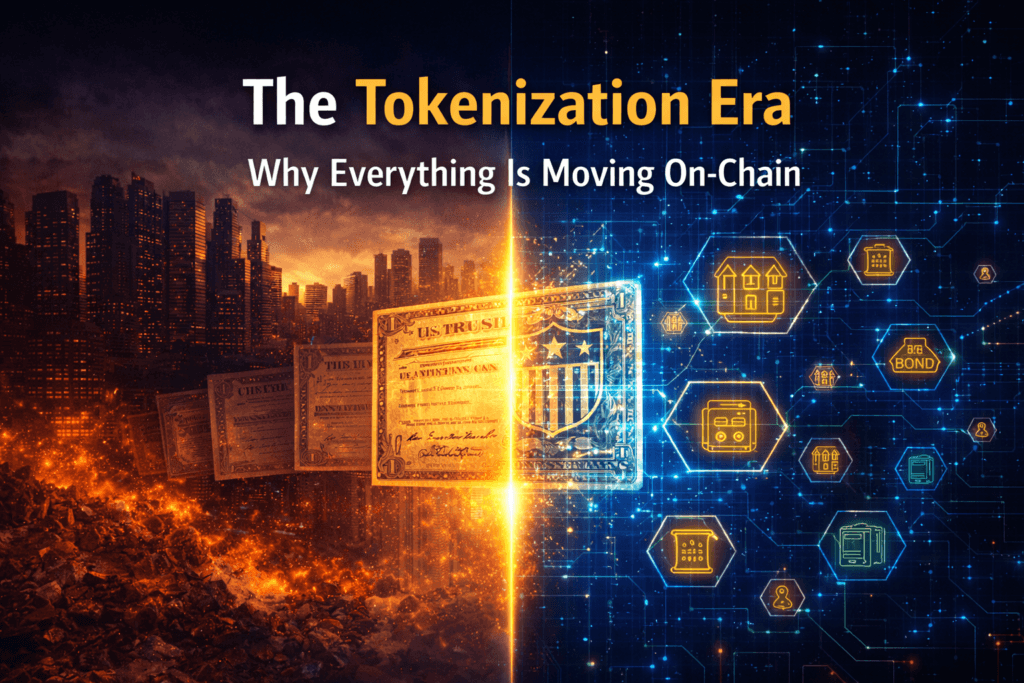
- Programmable
- Fractional
- Globally accessible
- Instantly settleable
Treasury bills, money market funds, bonds, and real estate can now trade 24/7 without traditional clearinghouses. The infrastructure changes and with it, the speed and efficiency of global capital.
Why Now? The Conditions That Created The Tokenization Era
Three forces are converging:
 Institutional Acceptance
 Institutional Acceptance
Major asset managers are experimenting with tokenized funds and blockchain settlement layers. When trillion-dollar firms begin testing on-chain issuance, the conversation shifts from “if” to “how fast.”
Yield Demand
 Yield Demand
In a higher-rate environment, tokenized treasuries offer on-chain yield without leaving crypto infrastructure. Investors no longer need to choose between DeFi liquidity and traditional returns.
Infrastructure Maturity
 Infrastructure Maturity
Public blockchains have matured. Smart contracts are audited. Custody solutions have improved. Regulatory clarity is slowly developoing. The Tokenization Era could not have begun five years ago. The rails were not ready. Now they are.
BlackRock And The Institutional Signal
Institutional involvement defines eras. When BlackRock explores tokenized funds and blockchain-based settlement mechanisms, it sends a signal: tokenization is infrastructure, not experimentation. The significance is not just symbolic. It changes capital flows.
Institutions care about:
- Operational efficiency
- Reduced settlement time
- Lower counterparty risk
- Transparent ownership records
Tokenization addresses all four. The Tokenization Era accelerates when the world’s largest asset managers seek cost reduction and programmable liquidity.
ONDO And The Rise Of Tokenized Treasuries
While traditional institutions explore blockchain rails, crypto-native platforms are building bridges. ONDO represents one of the clearest examples of tokenized real-world assets in action. By bringing U.S. Treasuries on-chain, it merges traditional yield with blockchain accessibility.
This matters for two reasons:
- It introduces regulated yield products into crypto markets.
- It demonstrates that tokenization works at scale.
In the Tokenization Era, capital does not need to leave blockchain networks to access real-world assets. It simply wraps them into digital form.
Crypto As The Settlement Layer
Tokenization depends on blockchain infrastructure. Bitcoin introduced the idea of fixed digital scarcity. Ethereum expanded it with programmable smart contracts. Stablecoins provided liquidity rails. Together, they form the backbone of the Tokenization Era. Without decentralized settlement layers, tokenization would simply be another centralized database upgrade. With blockchain, it becomes a global, interoperable system. The innovation is not just digitization. It is programmable ownership.
How The Tokenization Era Changes Markets
The long-term implications are significant.
Faster Settlement
Traditional securities settle in days. Tokenized assets can settle in minutes.
Fractional Ownership
High-value assets become accessible to smaller investors.
Global Liquidity
Assets no longer remain restricted to local markets.
Reduced Intermediaries
Clearinghouses, custodians, and settlement agents may see reduced roles as smart contracts automate processes. In short, the Tokenization Era compresses friction across capital markets.
Beyond Finance: The Expansion Of Tokenization
Today, the focus is on bonds & treasuries.
Tomorrow, it could include:
- Real estate portfolios
- Private equity funds
- Intellectual property
- Carbon credits
- Commodities
Everything that represents ownership can, in theory, exist on-chain. The Tokenization Era extends beyond Wall Street. It redefines how ownership itself functions.
Risks And Realities
Every structural shift carries risk. The Tokenization Era still faces:
- Regulatory uncertainty
- Custody vulnerabilities
- Smart contract risk
- Liquidity fragmentation
- Centralization concerns around issuers
Institutional participation reduces some risks but introduces others. Adoption will likely progress in stages rather than explode overnight.
The Bigger Picture: A Programmable Financial System
The Tokenization Era represents the merging of traditional finance and blockchain technology. This is not about replacing the existing system overnight. It is about upgrading it.
In a tokenized world:
- Bonds can rebalance automatically.
- Funds can distribute yield programmatically.
- Settlement can occur without manual reconciliation.
Capital markets become software-driven. That is the structural shift underway.
Final Thoughts On Tokenization Era
The Tokenization Era signals a deeper transformation than previous crypto cycles.
”Speculation built awareness and Infrastructure builds permanence.”
As institutions experiment, platforms innovate, and regulatory clarity improves, more assets will migrate on-chain. The question is no longer whether tokenization will happen. It is how much of the global financial system will move during the Tokenization Era and how quickly.
Ownership is becoming programmable with finance becoming digital. And everything is slowly moving on-chain.