
When the world enters periods of war, global conflict and geopolitical instability, markets do not simply react they reprice risk. Currencies weaken. Capital controls tighten. Inflation accelerates. Trust erodes.
In these moments, Bitcoin stops looking like a speculative tech asset and starts looking like something else entirely: neutral money in a fragmented world. Global conflict reveals the weaknesses of traditional financial systems. At the same time, it highlights why Bitcoin was designed in the first place (Bitcoin Whitepaper).
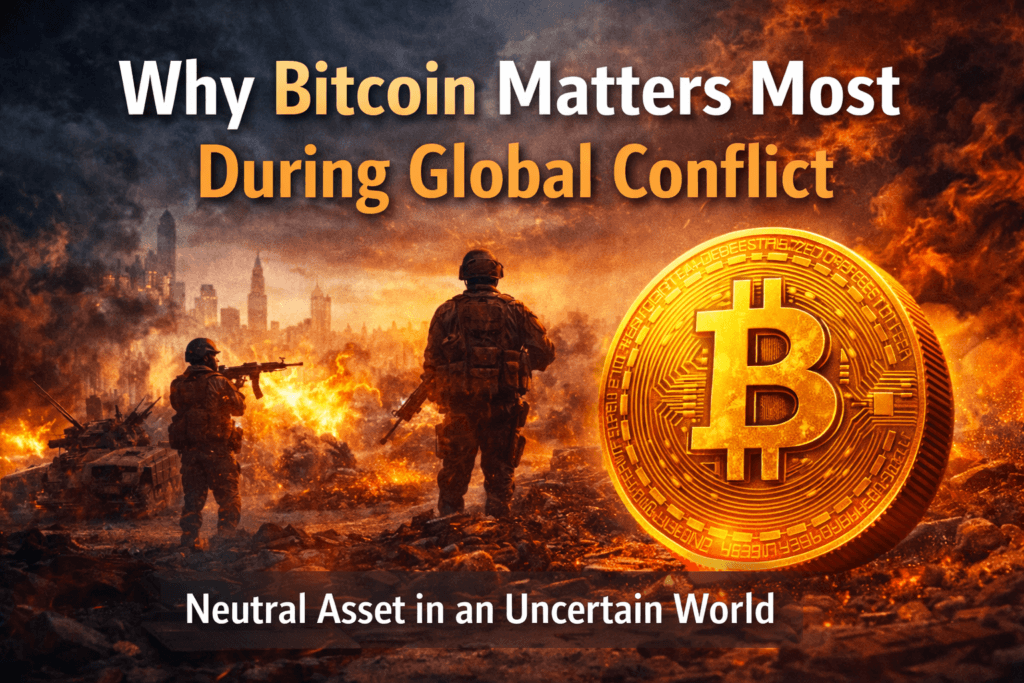
As global tensions rise, Bitcoin emerges as a politically neutral asset in a fragmented financial world.
War Breaks Currencies Before It Breaks Markets
History shows that war is inflationary. Governments finance military spending through debt expansion, currency debasement, and aggressive monetary policy. Defense budgets surge. Fiscal deficits widen. Central banks often monetize that debt.
The result?
• Rising inflation
• Weakening domestic currencies
• Declining purchasing power
During major global conflict, citizens in affected regions frequently rush toward hard assets like gold, foreign currency, real estate, and increasingly, Bitcoin. Unlike fiat, Bitcoin cannot be printed to fund a war. It’s supply remains fixed at 21 million. That constraint becomes more powerful when governments expand their balance sheets.
Sanctions And The Rise Of Financial Neutrality
Modern warfare extends beyond the battlefield. It now includes financial infrastructure. Sanctions can freeze reserves. Payment networks can exclude nations. Banks can block cross-border transactions overnight. This is where Bitcoin’s neutrality becomes critical.
Bitcoin does not recognize borders. It does not enforce sanctions. It does not discriminate between users. The network operates based on code, not geopolitics.
For individuals in sanctioned regions, Bitcoin can provide:
• Access to global liquidity
• Protection against capital controls
• An alternative to frozen banking systems
For investors, this neutrality reinforces Bitcoin’s long-term value proposition as a politically independent asset.
The Institutional Perspective: Conflict Increases Hedge Demand
Global conflict increases volatility across equities, bonds, and foreign exchange markets. When uncertainty rises, institutional allocators look for hedges. Traditionally, gold filled this role. Today, Bitcoin increasingly enters the discussion as digital gold.
Why? Because Bitcoin combines three key characteristics:
- Fixed supply
- Global liquidity
- Portability without intermediaries
Unlike gold, Bitcoin can move across borders instantly. Unlike sovereign bonds, it carries no counterparty risk tied to a government at war. As geopolitical fragmentation increases, neutral assets gain strategic importance.
Global Conflict, War, Inflation, and the Scarcity Premium
Wartime spending typically drives long-term inflation pressure. Even after global conflict subsides, debt remains. Bitcoin’s monetary policy does not adjust to global events. It does not respond to political pressure. It does not stimulate. The issuance schedule continues predictably. This predictability creates what many investors describe as a “scarcity premium.” The more unstable the macro environment becomes, the more valuable predictable supply appears.
In times of peace, scarcity is theoretical. In times of war, scarcity becomes protection.
The Psychological Shift: From Speculation To Sovereignty
During bull markets, many participants view Bitcoin as a high-growth asset. During geopolitical stress, the narrative changes.
Bitcoin becomes:
• A hedge against currency debasement
• A tool for cross-border survival
• A reserve asset outside political systems
The shift from speculation to sovereignty often occurs gradually. But history shows that crises accelerate adoption curves. Each global conflict reinforces the idea that financial systems are political tools. Bitcoin offers an alternative.
Network Resilience Under Stress
One overlooked factor during global conflict is network resilience. Despite regional wars, energy crises, regulatory shifts, and mining bans, the Bitcoin network has continued operating without interruption. Hash rate has recovered after disruptions. Mining has redistributed geographically. The protocol remains intact. This resilience strengthens Bitcoin’s credibility as a long-term infrastructure layer, not merely a market asset.
Is Bitcoin A Perfect Safe Haven?
Bitcoin still exhibits volatility. It can sell off during liquidity crises. It does not always rise immediately during geopolitical shocks.
However, long-term patterns suggest something deeper: As global trust in centralized systems weakens, demand for decentralized alternatives grows. Bitcoin does not depend on political stability. It exists precisely because political stability cannot be guaranteed.
The Bigger Picture: A Fragmented World Needs Neutral Money
The global order is shifting toward multipolarity. Trade blocs fragment. Alliances realign. Sanctions expand. Financial systems become tools of strategic leverage. In such an environment, neutral settlement layers gain importance. Bitcoin represents the first globally accessible, apolitical monetary network. During peace, this may feel optional. During conflict, it becomes essential.
Final Thoughts
War exposes fragility.
It reveals how quickly access to capital, liquidity, and banking can change. Bitcoin matters most during global conflict because it removes trust from the equation. It operates on rules, not relationships. When uncertainty rises, assets with predictable supply and political neutrality gain strategic value. The world may become more divided. Bitcoin remains borderless.
Plan your wealth goals with Bitcoin or any Crypto as asset using Crypto ROI Calculator.