
Corporate Bitcoin adoption is becoming one of the most important trends in modern finance as businesses increasingly explore Bitcoin as a treasury reserve asset alongside traditional holdings. For decades, companies have typically stored excess capital in assets such as:
🏦 Cash reserves
📄 Government bonds
📈 Stocks
🏢 Business investments
However, a growing number of corporations are now exploring Bitcoin as part of their treasury strategy. As institutional adoption expands, some investors are beginning to ask a fascinating question:
👉 What if every company added Bitcoin to its balance sheet?
In 2026, Bitcoin is increasingly being viewed not only as a speculative asset but also as a potential treasury reserve asset. While only a small percentage of companies currently hold Bitcoin, the implications of widespread corporate adoption could be enormous.
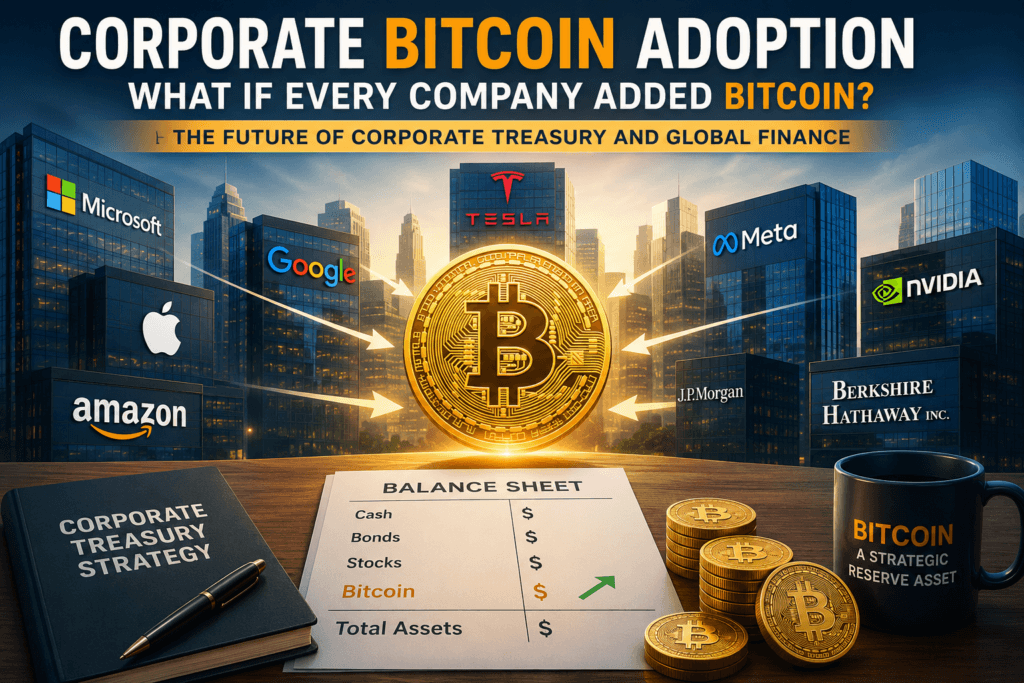
Corporate Bitcoin treasury illustration showing companies adding Bitcoin to balance sheets, institutional adoption, treasury reserves, and global financial transformation in 2026.
🏦 Why Companies Hold Cash Reserves
Most businesses maintain cash reserves for practical reasons.
These reserves help companies:
✔ Manage operating expenses
✔ Handle economic uncertainty
✔ Fund future growth
✔ Protect against financial shocks
Traditionally, excess capital has been stored in relatively conservative assets such as short-term government securities or cash equivalents. However, this approach is now being questioned by some corporate treasury managers.
Inflation has created new challenges for corporate treasury managers. When inflation rises, cash reserves may gradually lose purchasing power over time. This concern has led some companies to explore alternative reserve assets.
₿ Why Some Companies Are Buying Bitcoin
The idea of holding Bitcoin on a corporate balance sheet became mainstream after several high-profile firms began accumulating BTC. Public data tracking corporate Bitcoin ownership continues to show growing institutional participation. One of the most well-known examples is STRATEGY, whose aggressive Bitcoin accumulation strategy has inspired many corporate treasury discussions.
Supporters argue Bitcoin offers:
✔ Global liquidity
✔ Digital scarcity
✔ Independence from central bank policies
Unlike fiat currencies, Bitcoin has a maximum supply of 21 million coins. Therefore, many investors view this scarcity as a potential hedge against long-term monetary expansion. As a result, some companies now treat Bitcoin as a strategic reserve asset rather than simply a speculative investment.
🌍 What If Corporate Adoption Became Universal?
Imagine a world where most publicly traded companies allocated part of their treasury reserves to Bitcoin. Moreover, even a small allocation could create enormous demand.
For example:
🏢 Thousands of public companies
🏦 Financial institutions
🌍 Multinational corporations
📈 Large private firms
Since Bitcoin’s supply is fixed, increased demand without increased supply would likely place upward pressure on prices. Many analysts believe widespread corporate adoption could dramatically reduce the amount of Bitcoin available on exchanges.
Furthermore, if corporate Bitcoin adoption accelerated, many companies would likely require access to highly liquid and regulated crypto exchanges to execute large Bitcoin purchases efficiently. This could increase institutional demand for major trading platforms and custodial services.
📉 The Supply Shock Scenario
One of the most discussed outcomes of large-scale corporate adoption is a potential supply shock. A supply shock occurs when demand increases significantly while available supply remains limited.
Bitcoin already experiences scarcity because:
₿ New issuance declines every four years through halving events
🔐 Long-term holders often avoid selling
🏛 Institutions continue accumulating
📈 ETFs absorb additional supply
As a result, If thousands of companies began purchasing Bitcoin simultaneously, available market liquidity could tighten considerably. This could potentially increase price volatility and intensify competition for available coins.
🏛 Could Bitcoin Become A Standard Treasury Asset?
This is a near term possibility which we can’t ignore. Today, companies often hold:
💵 Cash
📄 Treasury bills
🏦 Money market instruments
📈 Short-term investments
Consequently, Bitcoin could potentially join this list as a recognized treasury asset. Some corporate leaders argue Bitcoin offers unique advantages:
✔ Scarcity
✔ Portability
✔ Transparency
✔ Global accessibility
If adoption expands, future corporate finance textbooks may discuss Bitcoin alongside traditional treasury management tools.
⚖ Potential Benefits For Companies
Companies that add Bitcoin to their balance sheets could potentially benefit from:
📈 Long-term appreciation
🌍 Global liquidity
⚡ Faster settlement capabilities
Furthermore, supporters believe Bitcoin may provide protection against currency debasement in certain economic environments. Additionally, companies operating internationally may find value in an asset that functions across borders without relying on a single national currency.
⚠️ Risks Companies Must Consider
Despite its potential benefits, Bitcoin introduces important risks. These include:
⚠️ Price volatility
⚠️ Accounting complexity
⚠️ Security requirements
⚠️ Shareholder concerns
Nevertheless, many corporate boards remain cautious because Bitcoin’s price can fluctuate significantly over short periods. Treasury management typically prioritizes stability, which can make Bitcoin adoption challenging for conservative organizations.
🏦 Could This Change Traditional Finance?
If corporate Bitcoin adoption accelerated dramatically, traditional finance could experience significant changes. Potential outcomes might include:
🌍 Reduced dependence on fiat reserves
🏛 New treasury management standards
📈 Greater institutional participation
⚡ Increased financial innovation
Meanwhile, some observers believe Bitcoin could eventually become a complementary reserve asset alongside traditional holdings rather than replacing them entirely.
🌐 The Global Competition Effect
If companies began viewing Bitcoin as a strategic reserve asset, competitive dynamics could emerge.
🏢 Early adopters may benefit from lower acquisition costs
📈 Later adopters may face higher prices
🌍 International competition could intensify
🏛 Corporate treasury strategies could evolve rapidly
Therefore, this creates a potential incentive for businesses to evaluate Bitcoin before widespread adoption occurs.
🔮 Could Every Company Actually Adopt Bitcoin?
In reality, universal adoption remains unlikely in the near future. Different industries face different requirements. Some companies prioritize:
✔ Stability
✔ Regulatory compliance
✔ Predictable cash flows
On the other hand, others may be more willing to accept volatility in pursuit of long-term gains. However, even partial adoption by a meaningful percentage of global corporations could have significant effects on Bitcoin markets and financial systems.
📚 Final Thoughts
The question of what would happen if every company added Bitcoin to its balance sheet highlights the growing role Bitcoin is playing within institutional finance. While universal adoption remains hypothetical, corporate interest in Bitcoin continues expanding as businesses explore new ways to preserve capital and diversify treasury reserves.
Supporters believe widespread adoption could:
✔ Increase demand
✔ Reduce available supply
✔ Strengthen Bitcoin’s position as a global reserve asset
✔ Accelerate institutional acceptance
Critics, however, continue to point to:
⚠️ Volatility
⚠️ Regulatory uncertainty
⚠️ Operational challenges
⚠️ Treasury management risks
In 2026, the idea of corporate Bitcoin ownership is no longer a fringe concept. Whether adoption remains limited or eventually becomes mainstream, Bitcoin’s role in corporate finance is likely to remain one of the most closely watched developments in the digital asset industry.
Key Takeaways
- Bitcoin is increasingly being considered as a corporate treasury reserve asset alongside traditional cash reserves and government securities.
- If every company added Bitcoin to its balance sheet, demand for BTC could increase dramatically while supply remains fixed.
- Widespread corporate adoption could potentially create a significant Bitcoin supply shock and reduce available market liquidity.
- Supporters believe Bitcoin offers scarcity, global accessibility, and protection against long-term currency debasement.
- Corporate Bitcoin adoption could accelerate institutional acceptance and reshape treasury management strategies.
- Companies must still consider risks such as volatility, regulatory uncertainty, security requirements, and accounting complexity.
- Universal corporate Bitcoin adoption remains unlikely in the near future, but even partial adoption could significantly impact global markets.
Frequently Asked Questions (FAQ)
What does it mean for a company to add Bitcoin to its balance sheet?
It means a company allocates part of its treasury reserves to Bitcoin and records it as a corporate asset alongside cash, investments, and other holdings.
Why are companies buying Bitcoin?
Some companies view Bitcoin as a scarce digital asset that may help preserve purchasing power, diversify treasury reserves, and provide long-term growth potential.
Would Bitcoin’s price increase if more companies bought it?
Potentially. Because Bitcoin has a fixed maximum supply of 21 million coins, increased corporate demand could place upward pressure on prices if supply remains limited.
What is a Bitcoin supply shock?
A supply shock occurs when demand rises significantly while available Bitcoin supply remains limited, potentially leading to higher prices and reduced market liquidity.
What risks do companies face when holding Bitcoin?
Major risks include price volatility, regulatory uncertainty, cybersecurity threats, accounting challenges, and shareholder concerns about treasury management decisions.
Could Bitcoin become a standard corporate treasury asset?
Some analysts believe Bitcoin could eventually become a recognized treasury reserve asset alongside cash and government securities, although widespread adoption is still developing.
Will every company eventually own Bitcoin?
Universal adoption is unlikely. Different companies have different risk tolerances, regulatory obligations, and financial objectives that influence treasury decisions.
How could widespread corporate Bitcoin adoption affect financial markets?
It could increase institutional participation, reduce available Bitcoin supply, influence treasury management practices, and further integrate digital assets into traditional finance.