
Financial privacy has long been one of the most overlooked yet essential components of personal freedom and economic independence. For centuries, cash has provided people with something many take for granted:
🔐 Financial privacy
Every time someone pays with physical cash, the transaction typically leaves little or no permanent digital record. However, as governments, banks, fintech companies, and digital payment systems increasingly move the world toward cashless transactions, many people are beginning to ask an important question:
👉 Will cash eventually disappear completely?
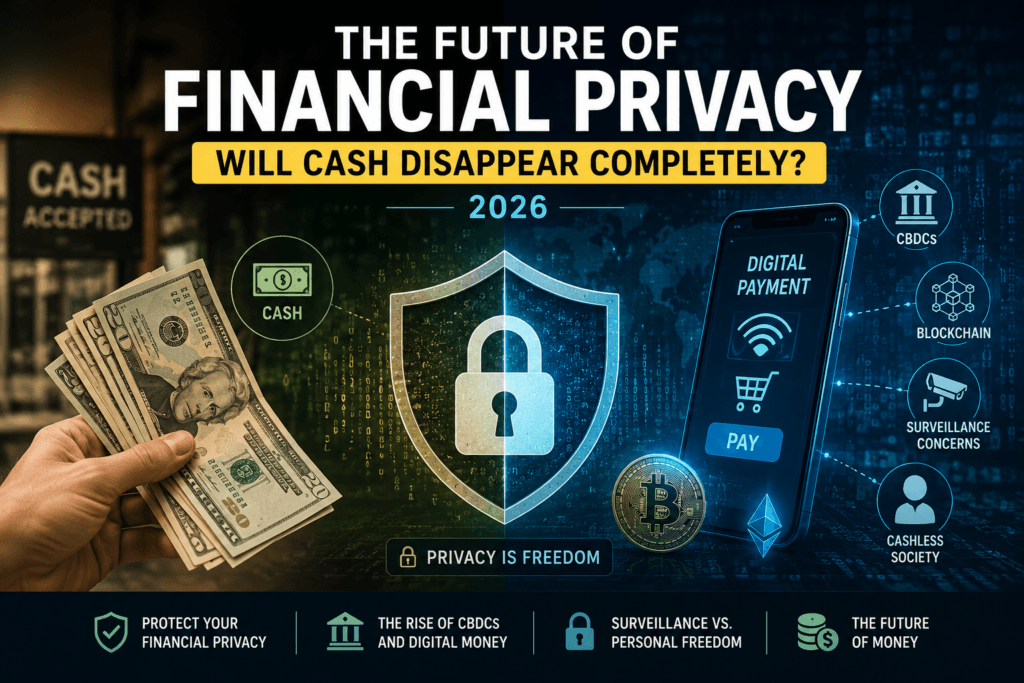
In 2026, the debate surrounding financial privacy is becoming one of the most important discussions shaping the future of money. Financial privacy illustration showing digital payments, cashless society, CBDCs, blockchain transactions, surveillance concerns, and the future of money in 2026.
A visual representation of how financial privacy may evolve as digital payments, blockchain technology, and government-issued digital currencies continue expanding worldwide.
🌍 Why Cash Has Always Been Important
Cash serves several important functions beyond simply making payments.
For many people, cash provides:
✔ Privacy
✔ Independence
✔ Accessibility
✔ Immediate settlement
✔ Protection from system outages
Unlike digital transactions, cash generally does not require:
⚠️ Internet access
⚠️ Banking approval
⚠️ Third-party verification
⚠️ Digital identity systems
For generations, cash has allowed individuals to exchange value directly without relying heavily on financial intermediaries.
📱 The World Is Rapidly Moving Toward Digital Payments
Across the globe, digital payment adoption continues accelerating. Today many consumers regularly use:
📱 Mobile payment apps
💳 Debit cards
💳 Credit cards
🏦 Online banking
🌐 Digital wallets
Governments and financial institutions often support digital payments because they can improve:
✔ Convenience
✔ Efficiency
✔ Tax collection
✔ Fraud monitoring
✔ Financial inclusion
For many consumers, digital payments are faster and easier than carrying physical cash. As a result, cash usage continues declining in several countries.
🏦 CBDCs Could Change Financial Privacy Forever
One major development attracting attention is the rise of:
🏦 Central Bank Digital Currencies (CBDCs)
CBDCs are government-issued digital currencies designed to operate alongside or potentially replace certain forms of traditional money.
Supporters argue CBDCs could provide:
✔ Faster payments
✔ Lower transaction costs
✔ Improved financial inclusion
✔ Modernized payment infrastructure
However, critics worry that CBDCs could significantly increase financial monitoring capabilities.
Some privacy advocates fear CBDCs may allow governments to track:
⚠️ Spending behavior
⚠️ Transaction history
⚠️ Financial activity
⚠️ Economic participation
This concern has become one of the central debates surrounding future digital currency systems.
🔐 Why Privacy Advocates Are Concerned
Financial privacy advocates argue that privacy is not merely about hiding wrongdoing. Instead, they believe privacy protects important freedoms including:
✔ Personal autonomy
✔ Freedom of association
✔ Protection from excessive surveillance
Critics of fully digital financial systems often ask:
👉 Should every financial transaction be permanently recorded?
👉 Who should have access to that information?
👉 How much financial data should governments or corporations collect?
These questions are becoming increasingly important as digital financial infrastructure expands globally.
₿ Bitcoin, Self-Custody And Alternative Financial Systems
As concerns about privacy grow, many individuals are exploring alternative financial systems. Some users are increasingly interested in:
₿ Bitcoin
🌍 Decentralized finance
⚡ Peer-to-peer transactions
Bitcoin offers a different approach to money by allowing users to hold assets directly without relying entirely on banks. However, Bitcoin transactions remain publicly visible on the blockchain. While Bitcoin can improve financial sovereignty, it does not provide complete transactional privacy. This distinction is often misunderstood by newer investors.
🕵️ Privacy Coins Continue Generating Debate
Some blockchain projects focus more directly on privacy.
Examples include:
Privacy-focused cryptocurrencies attempt to provide stronger transaction confidentiality than many public blockchains. Supporters argue these technologies help preserve legitimate financial privacy. Critics argue they may create challenges for law enforcement and regulatory oversight. As a result, privacy-focused cryptocurrencies remain one of the most debated sectors within the digital asset industry.
🌐 Governments Face A Difficult Balance
Most governments recognize the importance of combating:
⚠️ Money laundering
⚠️ Terrorism financing
⚠️ Fraud
⚠️ Organized crime
At the same time, policymakers must balance these concerns against individual rights and civil liberties.
Finding the correct balance between:
🔐 Privacy
and
may become one of the defining financial challenges of the next decade. Many experts believe future regulations will attempt to strike a middle ground between security and freedom.
📈 Technology Is Changing Financial Privacy
Artificial intelligence, blockchain analytics, and data aggregation tools continue expanding rapidly. Modern financial systems can increasingly analyze:
📊 Spending patterns
📊 Transaction behavior
📊 Consumer habits
📊 Financial relationships
Supporters argue these tools can improve security and fraud prevention. Critics worry they may gradually reduce personal financial privacy over time. The outcome will likely depend on how governments, companies, and societies choose to implement these technologies.
💰 Will Cash Actually Disappear?
Despite growing digital adoption, many experts do not believe cash will disappear completely anytime soon. Cash continues providing important advantages including:
✔ Privacy
✔ Accessibility
✔ Simplicity
✔ Resilience during outages
✔ Universal acceptance
Instead of disappearing entirely, cash may gradually become less common while digital payment systems become increasingly dominant. The future may involve a combination of:
💵 Cash
🏦 CBDCs
📱 Digital payments
₿ Cryptocurrencies
Rather than one system replacing all others, multiple forms of money may coexist for decades.
📚 Final Thoughts
The future of financial privacy remains one of the most important questions facing modern society.
As digital payments, CBDCs, blockchain technology, and data analytics continue evolving, governments and citizens will increasingly face difficult decisions regarding the balance between convenience, security, and freedom.
♦️ Supporters of digital finance emphasize efficiency and innovation.
♦️ Privacy advocates emphasize personal autonomy and civil liberties.
In 2026, the debate is no longer simply about technology. It is increasingly about how much financial privacy individuals will retain in an increasingly digital world. Whether cash eventually disappears completely remains uncertain, but the conversation surrounding financial privacy is likely to become far more important in the years ahead.
Key Takeaways
- Financial privacy is becoming a major issue as digital payments increasingly replace physical cash.
- Cash remains one of the few payment methods that allows transactions without creating permanent digital records.
- CBDCs could improve payment efficiency but may also increase financial monitoring and surveillance capabilities.
- Bitcoin provides financial sovereignty but does not offer complete transaction privacy due to its public blockchain.
- Privacy-focused cryptocurrencies such as Monero and Zcash aim to enhance transaction confidentiality.
- Governments face the challenge of balancing financial privacy with security, compliance, and anti-money laundering objectives.
- Digital payment adoption continues accelerating globally, but most experts do not expect cash to disappear completely in the near future.
- The future financial system may include cash, CBDCs, cryptocurrencies, stablecoins, and digital payment networks operating together.
Frequently Asked Questions (FAQ)
What is financial privacy?
Financial privacy refers to an individual’s ability to manage money and conduct transactions without excessive monitoring, tracking, or disclosure of personal financial information.
Why is cash considered important for financial privacy?
Cash transactions generally do not create permanent digital records, allowing people to exchange value directly without extensive third-party tracking.
Will cash disappear completely?
Most experts believe cash usage may continue declining, but cash is unlikely to disappear entirely because it provides accessibility, privacy, and resilience during system outages.
What are CBDCs?
CBDCs (Central Bank Digital Currencies) are digital forms of government-issued money designed to modernize payment systems and financial infrastructure.
Does Bitcoin provide complete privacy?
No. Bitcoin transactions are publicly recorded on the blockchain. While Bitcoin supports financial sovereignty, it does not offer complete transactional privacy.
What are privacy coins?
Privacy coins such as Monero (XMR) and Zcash (ZEC) are cryptocurrencies designed to provide greater transaction confidentiality than most public blockchain networks.
Why are governments concerned about privacy-focused financial technologies?
Governments often worry that highly private financial systems could make it more difficult to combat money laundering, fraud, terrorism financing, and other illegal activities.
Can digital payments and cash coexist?
Yes. Many experts believe future financial systems will likely include a combination of cash, digital payments, cryptocurrencies, stablecoins, and CBDCs.