
Crypto credit cards are rapidly changing how people think about spending, banking, and digital assets. For decades, consumers have relied on traditional financial institutions for everyday payments through:
🏦 Bank accounts
💳 Credit cards
💵 Cash withdrawals
📱 Mobile banking apps
However, cryptocurrency is beginning to blur the lines between banking and digital finance. As crypto payment technology improves, many people are starting to ask a fascinating question:
👉 Will banks eventually become invisible behind crypto-powered payment networks?
In 2026, crypto credit cards are becoming increasingly popular as exchanges, fintech companies, and payment providers compete to make digital assets easier to spend in everyday life.
Crypto credit cards are bridging the gap between digital assets and traditional payments, allowing users to spend crypto almost anywhere conventional cards are accepted.
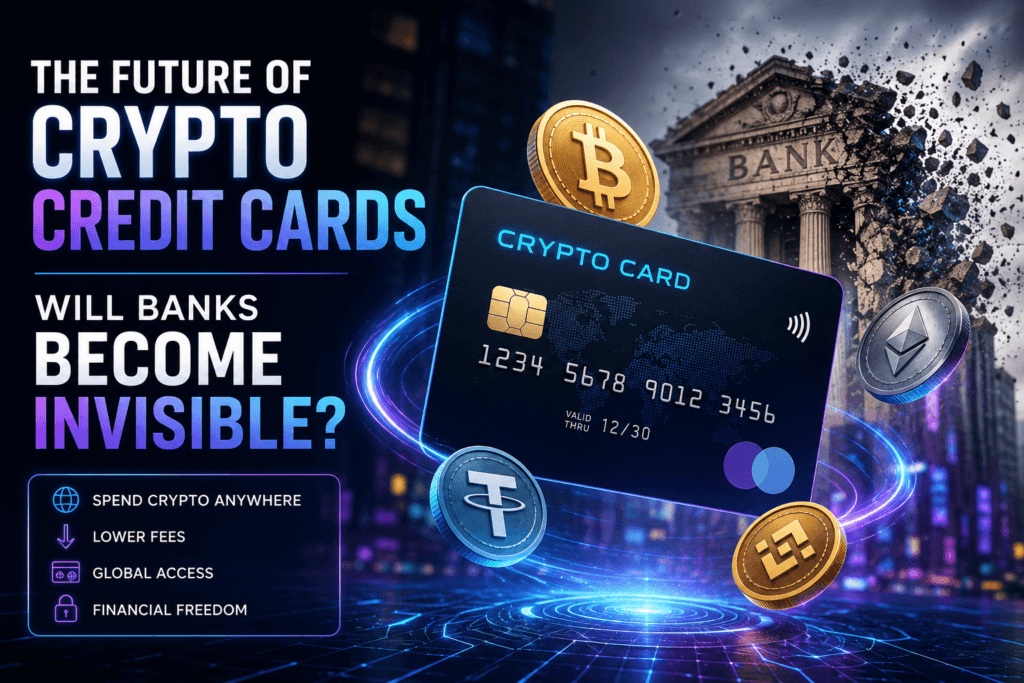
💳 What Are Crypto Credit Cards?
Many crypto credit cards are issued through major cryptocurrency platforms that combine trading, wallets, rewards programs, and payment services. As competition increases, exchanges (Binance, Pionex, Kucoin, Wazirx) are expanding beyond trading and increasingly positioning themselves as full-service financial platforms.
Despite the name, most crypto credit cards function more like debit cards.
✔ Hold cryptocurrency in a wallet or exchange account
✔ Connect that balance to a payment card
✔ Spend funds at traditional merchants
✔ Convert crypto into fiat currency during transactions
The process often feels identical to using a traditional bank card. However, cryptocurrency may be funding the purchase behind the scenes.
🌍 Why Crypto Cards Are Growing
Several factors are driving adoption. These include:
📱 Improved payment technology
⚡ Faster settlement systems
🌐 Global accessibility
🎁 Crypto reward programs
Many users appreciate the ability to spend digital assets without first transferring funds to a bank account. In addition, reward programs and improved usability continue attracting new users.
🏦 The Traditional Banking Model
Historically, banks have acted as financial intermediaries. They typically provide:
✔ Account storage
✔ Payment processing
✔ Lending services
✔ Currency conversion
✔ Transaction verification
Every purchase often passes through multiple institutions before reaching the merchant. As a result, transaction processing can become more complex and expensive. While this system works well, it can also introduce delays, fees, and operational complexity.
⚡ How Crypto Changes The Process
Cryptocurrency introduces an alternative financial infrastructure. Instead of relying entirely on traditional banking networks, transactions may involve:
💳 Crypto payment providers
🏦 Partner banking institutions
⚡ Stablecoin settlement systems
🌍 Global payment rails
As a result, consumers may interact less directly with traditional banks even when banks remain part of the underlying infrastructure.
🤔 What Does “Invisible Banking” Mean?
Invisible banking does not necessarily mean banks disappear. Instead, banks may operate in the background while users interact primarily with:
💳 Crypto payment cards
🌐 Financial apps
⚡ Stablecoin networks
🔐 Digital asset platforms
Consumers may not care whether a transaction passes through a traditional bank if the payment experience remains seamless. In other words, convenience often matters more than the underlying infrastructure.
💰 Stablecoins Could Accelerate The Trend
Stablecoins may play a critical role in the future of crypto payments. Unlike volatile cryptocurrencies, stablecoins are designed to maintain relatively stable values. Popular examples include:
💵 USDT
💵 USDC
💵 Other regulated stablecoins
Because price volatility is reduced, stablecoins may be more practical for everyday purchases than many traditional cryptocurrencies. Therefore, many analysts view stablecoins as a key bridge between traditional finance and crypto payments.
🚀 Potential Benefits For Consumers
If crypto credit cards continue evolving, users could potentially benefit from:
✔ Faster international payments
✔ Lower transaction costs
✔ Reduced currency conversion friction
✔ Greater financial flexibility
Furthermore, people in regions with limited banking access may gain new financial opportunities through crypto-powered payment networks.
⚠️ Challenges Still Remain
Despite growing adoption, several challenges remain. These include:
⚠️ Regulatory uncertainty
⚠️ Tax reporting complexity
⚠️ Merchant adoption barriers
⚠️ Dependence on payment partners
Governments and regulators continue developing frameworks for crypto payments. Consequently, future adoption may depend heavily on regulatory developments.
🏛 Why Banks May Still Matter
Even in a crypto-focused future, banks could remain important.
Banks continue providing:
🏦 Credit creation
🏠 Mortgage lending
🏢 Business financing
💰 Large-scale liquidity
Rather than disappearing completely, banks may evolve into infrastructure providers that support crypto-based financial services. Meanwhile, consumers may interact more frequently with crypto apps than with traditional banking platforms.
🔮 What Could The Next Decade Look Like?
Over the next decade, consumers may increasingly use:
💳 Crypto cards
📱 Digital wallets
🌍 Cross-border payment apps
🤖 AI-powered financial tools
As financial technology advances, the distinction between traditional banking and crypto finance may become less obvious to everyday users. Ultimately, many consumers may focus on convenience rather than the technology powering their transactions.
📚 Final Thoughts
The future of crypto credit cards is about much more than payment convenience. These products represent a broader shift toward digital financial systems that operate across borders and outside many traditional banking limitations. Moreover, they demonstrate how quickly payment technology is evolving.
Supporters believe:
✔ Crypto payments will become more mainstream
✔ Stablecoins will improve spending efficiency
✔ Digital wallets will become primary financial tools
✔ Banking services will increasingly move into the background
On the other hand, not everyone is convinced that crypto payment systems will replace traditional banking relationships.
Critics, however, argue:
⚠️ Regulation may slow adoption
⚠️ Banks remain essential to the economy
⚠️ Security challenges still exist
⚠️ Consumer trust takes time to build
In 2026, banks are far from disappearing. Nevertheless, crypto credit cards are providing a glimpse into a future where financial services may become increasingly invisible, automated, and integrated into the digital platforms people use every day.
Key Takeaways
- Crypto credit cards allow users to spend cryptocurrency through traditional payment networks while often converting assets into fiat at the point of sale.
- Growing crypto ownership, stablecoin adoption, and improved payment infrastructure are driving interest in crypto-powered payment solutions.
- The concept of “invisible banking” suggests that consumers may increasingly use crypto wallets and financial apps without directly interacting with traditional banks.
- Stablecoins could play a major role in the future of crypto payments by reducing volatility and improving everyday usability.
- Despite innovation, challenges such as regulation, taxation, security, and merchant adoption continue to affect the sector.
- Banks are unlikely to disappear completely but may evolve into infrastructure providers supporting crypto-based financial services.
- The future of payments may involve a blend of crypto cards, stablecoins, digital wallets, and traditional banking systems working together.
Frequently Asked Questions (FAQ)
What is a crypto credit card?
A crypto credit card is a payment card that allows users to spend cryptocurrency for everyday purchases. Most crypto cards function similarly to debit cards by converting crypto into fiat currency when a transaction occurs.
Do crypto credit cards replace traditional banks?
No. Crypto credit cards do not eliminate banks entirely. Instead, they may reduce direct interaction with banks while traditional institutions continue providing services such as lending, liquidity, and regulatory compliance.
Can you spend Bitcoin using a crypto card?
Yes. Many crypto cards allow users to spend Bitcoin and other cryptocurrencies by automatically converting them into local currency during payment.
Why are stablecoins important for crypto payments?
Stablecoins help reduce the volatility associated with cryptocurrencies, making them more practical for everyday purchases and payment transactions.
Are crypto credit cards available worldwide?
Availability varies by country and regulatory environment. Many providers offer crypto cards in selected regions, while others face restrictions due to local regulations.
What are the risks of using crypto credit cards?
Potential risks include regulatory changes, tax reporting requirements, security concerns, platform risk, and cryptocurrency price volatility.
Will crypto credit cards become mainstream?
Many industry participants believe crypto cards could become more common as digital asset adoption grows, stablecoin usage expands, and payment technology continues improving.