
For years, Bitcoin dominated institutional crypto narratives as digital gold. But quietly, a different structural shift has been unfolding. While Bitcoin attracts treasury allocations and ETF inflows, Ethereum is evolving into infrastructure, positioning itself as the Ethereum Wall Street’s Settlement Layer.
”Wall Street isn’t just buying ETH. It’s building on it.”
From tokenized treasuries to stablecoin settlements and real-world asset (RWA) issuance, Ethereum is increasingly functioning as the base settlement layer for institutional finance. This isn’t speculation, it’s structural adoption. As institutional interest in Ethereum grows, retail investors increasingly track performance and long-term return potential using crypto ROI tools.
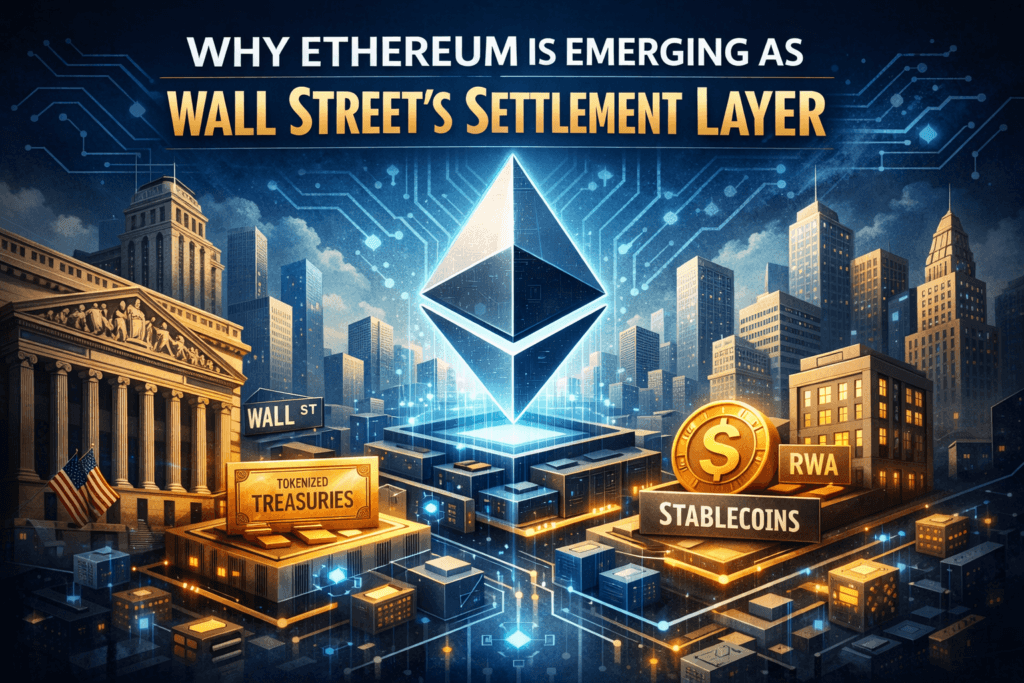
Visual representation of the Ethereum Wall Street’s Settlement Layer as institutions move tokenized assets and stablecoin settlements on-chain.
From Speculative Asset to Financial Infrastructure
Ethereum was initially valued for:
- Smart contracts
- DeFi innovation
- NFT markets
Today, institutions see something different:
- Programmable settlement
- Composable financial infrastructure
- Global 24/7 clearing layer
Unlike traditional systems that rely on intermediaries and batch settlement, Ethereum enables atomic, near-instant finality. That matters to institutions.
Settlement efficiency reduces:
- Counterparty risk
- Operational complexity
- Capital lockups
Wall Street understands this language.
Tokenized Treasuries and Real-World Assets
The tokenization narrative has moved from theory to execution.
Major asset managers are now issuing:
- Tokenized U.S. Treasuries
- On-chain money market funds
- Blockchain-based private credit products
Ethereum is the primary chain used for these issuances. Why?
Because it offers:
- Deep liquidity
- Proven security track record
- Institutional-grade custody integration
- Smart contract flexibility
Tokenized assets require a programmable base layer. Ethereum provides that.
Stablecoins: The Institutional Bridge
Stablecoins are no longer retail trading tools.
They are:
- Dollar settlement rails
- Cross-border liquidity bridges
- On-chain collateral instruments
Most major stablecoins operate on Ethereum or its scaling ecosystem. When institutions settle tokenized treasuries or move capital between blockchain-based products, stablecoins act as the cash leg of the transaction. Ethereum becomes the clearing house.
Ethereum’s Yield Component Attracts Capital
Unlike Bitcoin, Ethereum offers staking yield. For institutions, that changes portfolio math.
ETH is not just:
- A speculative asset
- A technology bet
It can also function as:
- A productive reserve asset
- Collateral generating native yield
Staking reduces circulating supply while increasing security, creating a feedback loop between capital and network strength.
Institutional DeFi Is Emerging
Early DeFi was retail-dominated.
Now we’re seeing:
- Permissioned liquidity pools
- On-chain KYC frameworks
- Institutional lending platforms
These are not experimental playgrounds. They are financial rails being rebuilt with compliance in mind. Ethereum remains the dominant smart contract platform supporting this development.
Layer 2 Scaling Strengthens the Case
High fees once limited institutional usability.
Layer 2 networks now provide:
- Lower transaction costs
- Faster throughput
- Scalable settlement environments
Institutions can issue, settle, and rebalance tokenized assets efficiently without sacrificing Ethereum’s base-layer security. This hybrid model (L2 execution + L1 security) mirrors traditional financial clearing systems but with programmability.
Why This Matters for ETH Accumulation
If Ethereum becomes the settlement layer for tokenized assets, then ETH serves multiple structural roles:
- Gas asset
- Collateral
- Staking instrument
- Liquidity reserve
As more assets move on-chain:
- Transaction demand increases
- Staking participation rises
- Liquid supply tightens
This is not just price speculation. It’s infrastructure-driven demand.
Risks to the Thesis
No structural shift is guaranteed.
Key risks include:
- Regulatory pressure on tokenization
- Competing blockchains attracting institutional flows
- Security vulnerabilities
- Custody concentration risks
Institutional adoption moves slowly but once integrated, it tends to be sticky. The question isn’t whether tokenization will grow. It’s which chain becomes the backbone.
Track Ethereum Market Opportunities
- Compare ETH returns with our ROI calculator
- Analyze spreads using our Arbitrage Matrix
- Optimize execution using our Fee Comparison tool
Conclusion
Bitcoin may remain the store-of-value asset. But Ethereum is positioning itself as something different: The programmable settlement layer of modern finance.
If tokenized treasuries, on-chain funds, and institutional DeFi continue expanding, Ethereum’s role could evolve from speculative infrastructure to foundational financial plumbing. Wall Street may not be shouting about Ethereum accumulation. But structurally, it may already be building around it.