
For centuries, the future of financial privacy was rarely questioned because people could still:
💵 use cash privately
🏦 store money in banks
📄 make purchases without constant digital tracking
But in 2026, the global financial system is rapidly changing. As economies become increasingly digital, governments, banks, and technology companies are gaining more visibility into how people:
✔ spend money
✔ transfer assets
✔ save wealth
✔ invest funds
✔ move capital globally
🔐 Will true financial privacy still exist in a fully digital economy?
As digital payments, blockchain systems, AI monitoring, and Central Bank Digital Currencies (CBDCs) continue expanding worldwide, concerns around financial surveillance and personal freedom are becoming increasingly important.
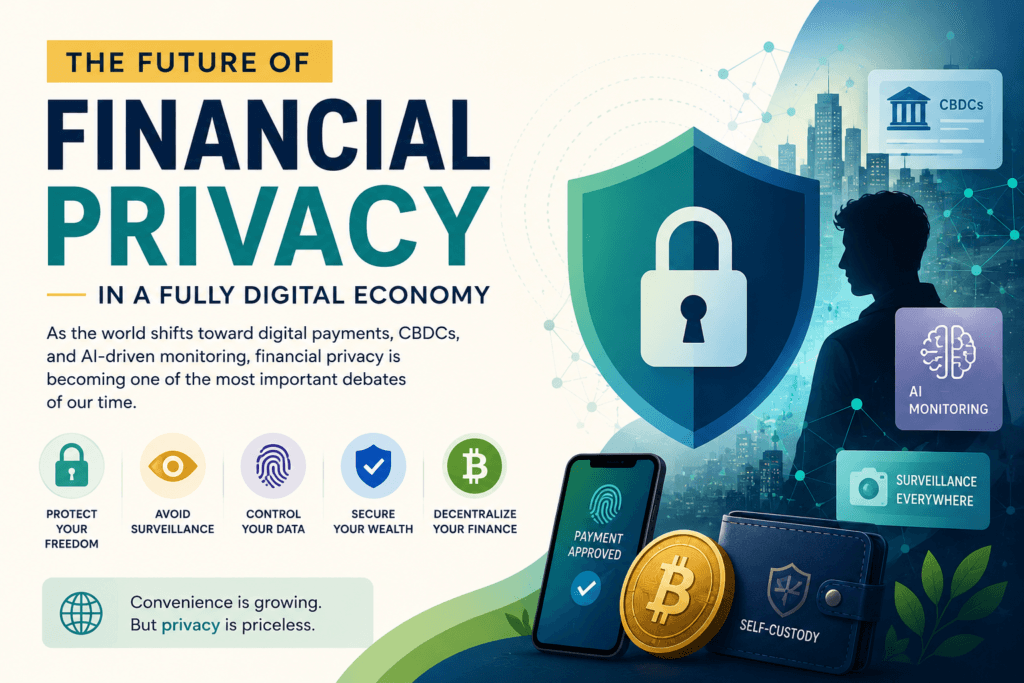
🌍 The World Is Moving Toward Fully Digital Finance
Around the world, physical cash usage continues declining.
Consumers increasingly rely on:
📱 mobile banking
💳 digital payments
🌐 online transactions
⚡ instant transfers
🏦 fintech platforms
At the same time, governments and financial institutions are rapidly building:
- CBDCs
- digital identity systems
- AI-driven compliance tools
- real-time payment infrastructure
- blockchain settlement networks
Critics worry this shift could reduce financial privacy significantly. However, supporters also argue that these technologies can:
✔ reduce fraud
✔ improve efficiency
✔ increase financial inclusion
✔ modernize outdated banking systems
👁 Why Financial Privacy Matters
Financial privacy is not only about hiding money.
For many people, it represents:
🔐 personal freedom
⚖ civil liberties
🛡 protection from abuse
🌍 economic independence
The ability to control personal financial information has historically protected individuals from:
- political persecution
- financial discrimination
- identity theft
- authoritarian overreach
- excessive surveillance
Critics of fully digital financial systems argue that if every transaction becomes permanently trackable, individuals may lose an important layer of personal autonomy. This debate becomes even more sensitive as governments gain more technological tools to monitor financial activity.
🏦 CBDCs And Financial Surveillance Concerns
One of the largest discussions surrounding financial privacy involves:
🏦 Central Bank Digital Currencies (CBDCs)
CBDCs are government-issued digital currencies designed to modernize payment systems and improve financial infrastructure.
Supporters believe CBDCs could:
✔ lower transaction costs
✔ improve payment efficiency
✔ increase financial access
✔ reduce illegal activity
However, critics worry CBDCs could also create systems capable of:
⚠ tracking transactions in real time
⚠ monitoring personal spending habits
⚠ limiting financial activity
⚠ enforcing programmable restrictions
⚠ increasing centralized control over money
While not all CBDC systems would function this way, the possibility has intensified global discussions around digital financial privacy.
🤖 AI Is Expanding Financial Monitoring
Artificial intelligence is also becoming deeply integrated into modern financial systems.
Banks, governments, and financial platforms increasingly use AI to:
✔ detect fraud
✔ monitor suspicious transactions
✔ enforce AML compliance
✔ analyze spending behavior
✔ identify financial risks
Blockchain analytics companies are rapidly expanding tools for transaction monitoring and compliance analysis.
As AI systems become more advanced, financial monitoring may become:
⚡ faster
🌍 more global
📊 more predictive
🤖 increasingly automated
Some experts believe future AI systems could eventually analyze massive amounts of financial data in real time. Supporters view this as necessary for:
- security
- fraud prevention
- tax compliance
Critics worry it could gradually normalize large-scale financial surveillance. Some analysts also believe future crypto tax reporting requirements may become significantly stricter in fully digital financial systems.
🔐 Why Bitcoin And Self-Custody Matter To Privacy Advocates
For many Bitcoin supporters, financial privacy is one of the core reasons decentralized assets remain important.
Unlike traditional banking systems, Bitcoin allows individuals to:
✔ hold assets independently
✔ transfer value globally
✔ reduce reliance on centralized intermediaries
✔ maintain partial financial sovereignty
In some parts of the world, Bitcoin is increasingly viewed as an alternative to traditional monetary systems during periods of economic instability.
Self-custody wallets give users direct control over their assets without relying entirely on banks or custodial institutions. While Bitcoin transactions remain publicly visible on the blockchain, supporters argue self-custody still offers an important layer of independence compared to fully centralized financial systems.
This is one of reason why some of the below mentioned factors are still gaining attention globally:
🔐 self-custody
🛡 privacy tools
🌍 decentralized finance
⚡ peer-to-peer payments
🕵 Privacy Coins And Anonymous Transactions
Some cryptocurrency projects focus even more heavily on financial privacy. Privacy-focused cryptocurrencies attempt to reduce transaction traceability through advanced cryptographic technologies.
Supporters argue privacy tools help:
✔ protect personal security
✔ preserve civil liberties
✔ prevent excessive surveillance
Even institutions are beginning to explore privacy-focused blockchain technologies for future financial infrastructure. Critics argue these technologies may also complicate:
⚠ law enforcement
⚠ tax enforcement
⚠ anti-money laundering efforts
As a result, privacy coins remain one of the most controversial areas of the crypto industry. The debate between Zcash and Monero also highlights how privacy-focused blockchain technologies are rapidly evolving.
⚖ The Debate: Convenience vs Privacy
Modern digital finance offers enormous convenience.
Consumers today can:
📱 send payments instantly
🌍 move money globally
💳 shop online effortlessly
⚡ access financial services from anywhere
But critics argue convenience often comes with a hidden cost:
👁 increased financial visibility
This creates one of the defining questions of the digital economy:
👉 How much privacy are people willing to sacrifice for convenience and security?
The answer and the clarity on this may shape:
- banking systems
- government policy
- crypto adoption
- digital identity frameworks
- the future of personal freedom
🌐 The Future May Be Hybrid Financial Systems
The future of finance may not become fully private or fully transparent.
Instead, many experts believe hybrid systems could emerge that combine:
✔ digital efficiency
✔ regulatory compliance
✔ limited privacy protections
✔ decentralized financial tools
In this environment, users may increasingly choose between:
🏦 fully regulated financial systems
or
🔐 privacy-focused alternatives
This balance between security, regulation, and personal freedom may become one of the most important economic debates of the digital era.
📚 Final Thoughts
Financial privacy is rapidly becoming one of the defining issues of the modern digital economy as:
🏦 CBDCs expand
🤖 AI monitoring grows
🌍 digital payments dominate
⚡ blockchain systems evolve
The relationship between money, privacy, and personal freedom is changing faster than ever before. Bitcoin is increasingly being discussed not only as a speculative asset, but also as a long-term tool for monetary sovereignty.
For governments, increased financial visibility may improve compliance and security. For privacy advocates, however, the decline of anonymous financial activity raises important concerns about surveillance, autonomy, and centralized control.
In years ahead, the future of financial privacy will likely depend on how societies balance:
⚖ innovation
🔐 individual freedom
🏦 regulation
🤖 technology
Key Takeaways
- Financial privacy is becoming a major global concern as economies move toward fully digital financial systems.
- CBDCs, AI-driven monitoring, and digital payment infrastructure may significantly increase financial visibility.
- Supporters of digital finance believe these systems can improve efficiency, security, and fraud prevention.
- Critics worry excessive financial surveillance could reduce personal freedom and economic privacy.
- Bitcoin, self-custody wallets, and privacy-focused technologies are gaining attention as alternatives to centralized financial control.
- The future of financial privacy may depend on how societies balance innovation, regulation, security, and individual freedom.
Frequently Asked Questions (FAQ)
What is financial privacy?
Financial privacy refers to an individual’s ability to control and protect personal financial information, transactions, and spending activity from unnecessary surveillance or exposure.
Why is financial privacy becoming important in 2026?
As digital payments, CBDCs, AI monitoring, and blockchain-based systems expand globally, concerns around financial tracking and surveillance are increasing.
How could CBDCs affect financial privacy?
Some critics believe CBDCs could allow governments to monitor transactions more closely, while supporters argue they can improve efficiency, security, and financial inclusion.
Why do Bitcoin supporters care about financial privacy?
Many Bitcoin supporters value self-custody and decentralized finance because they reduce dependence on centralized institutions and provide greater financial autonomy.
What are privacy coins in crypto?
Privacy coins are cryptocurrencies designed to reduce transaction traceability and improve user anonymity through advanced cryptographic technologies.
Will financial privacy disappear in the future?
Financial privacy may not disappear completely, but the balance between convenience, regulation, security, and personal freedom will likely become one of the biggest debates in the digital economy.