
 What Is TRON (TRX)?
 What Is TRON (TRX)?
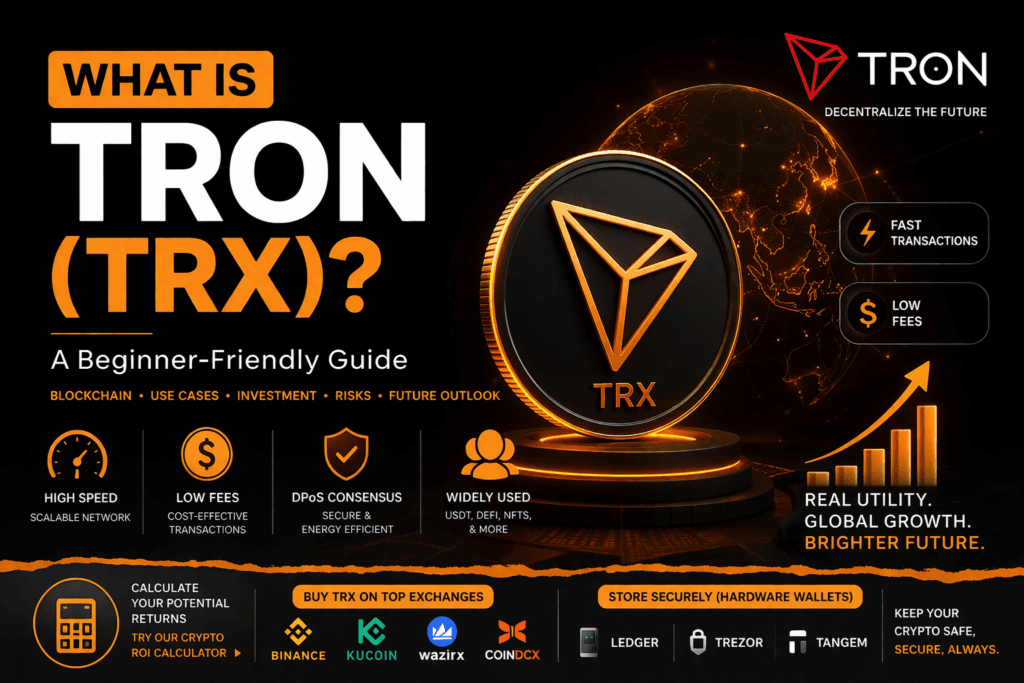
TRON (TRX) is a decentralized blockchain platform designed to host smart contracts and decentralized applications (dApps). Unlike older blockchains focused primarily on peer-to-peer value (like Bitcoin), TRON aims to democratize content distribution, entertainment, and decentralized finance.
At its core:
- TRON is the blockchain network
- TRX is the native cryptocurrency
- TRX can be used for transactions, staking, voting, and smart contract execution
The network is known for:
- High throughput
- Low transaction fees
- Scalability designed for large-scale consumer adoption
The Origin of TRON & TRX
 The Origin of TRON & TRX
TRON was founded in 2017 by Justin Sun, a young entrepreneur from China who previously served as the representative of Ripple in Greater China. Sun registered TRON in Singapore rather than China to avoid local regulatory constraints on cryptocurrencies.
Initial highlights:
- Whitepaper release: 2017
- Mainnet launch: 2019
- TRON absorbed the decentralized peer-to-peer content platform BitTorrent, bringing millions of users into its ecosystem
Since its launch, TRON has aimed to create a decentralized internet where content creators can share digital media without intermediaries.
China, Hong Kong & Regulatory Impact on TRON
TRON’s origin story is deeply linked with China’s broader crypto ecosystem. While China itself has banned crypto trading and mining since 2021, the TRON project has evolved abroad and continues to thrive in decentralized finance environments.
China’s Regulation
In China, domestic crypto trading and exchanges are largely prohibited. This forced many blockchain projects, including TRON, to base operations outside the Chinese mainland, especially in:
- Singapore
- Hong Kong
- Southeast Asia
Interestingly, Hong Kong has taken a more balanced approach:
 It has introduced licensing frameworks for exchanges It allows qualified institutional participation It aims to attract blockchain startups
As a result, TRON development and adoption continued despite mainland restrictions. Many developers and communities within Greater China operate from Hong Kong or overseas addresses to stay compliant.
Regulatory Relevance for Investors
Regulation influences:
- Exchange availability in certain regions
- Access to offshore trading for Chinese users
- Institutional participation
Understanding TRON’s relationship with these jurisdictions helps investors anticipate compliance, adoption, and market maturity trends.
How TRON Works – The Technology Explained
 How TRON Works – The Technology Explained
At a high level, TRON uses a Delegated Proof of Stake (DPoS) consensus model.
What does that mean?
Instead of energy-intensive mining like Bitcoin, TRON relies on:
- Super Representatives (SRs): Elected nodes that validate blocks
- Stakers: Users who lock TRX to vote for SRs
- Low fees: Designed to make transactions fast and cheap
This enables transaction speeds that are faster than many older blockchains.
TRON’s architecture allows for:
- Decentralized applications (dApps)
- Smart contracts
- Token issuance (TRC-20 tokens like USDT on Tron)
- Scalability for consumer usage
TRON’s Key Use Cases
 TRON’s Key Use Cases
1. Decentralized Finance (DeFi)
TRON hosts a variety of DeFi protocols, including:
- JustLend
- SunSwap
- Other liquidity and yield platforms
2. Stablecoin Volume
A significant portion of USDT (Tether) circulation happens on TRON’s network due to low fees and high throughput. You can compare historical USDT/Stablecoin throughput using our Historical ROI Performance tool to see how TRON volume has grown compared to other chains.
Growth Drivers in 2026
 Growth Drivers in 2026
There are several reasons TRON continues to attract attention from investors and builders:
Low Transaction Fees
 Low Transaction Fees
TRON transactions are nearly free, ideal for retail and high-frequency activity.
Rapid Adoption of dApps
 Rapid Adoption of dApps
Games, DeFi, and entertainment apps built on TRON help grow on-chain activity.
Stablecoin Dominance
 Stablecoin Dominance
TRON hosts a major share of USDT transactions, which reinforces recurring economic activity.
Interoperability & Bridges
 Interoperability & Bridges
Cross-chain bridges and compatibility increase utility beyond the native TRON ecosystem.
Risks to Consider
 Risks to Consider
No investment is without risk, and TRON has its share:
Market Volatility
 Market Volatility
Like all crypto assets, TRX prices swing widely. A drawdown of 40-80% in bear markets is common.
Centralization Concerns
Some critics claim TRON’s governance and node selection may be more centralized than ideal.
Regulatory Uncertainty
 Regulatory Uncertainty
New global regulations (especially in the U.S. and EU) could impact how exchanges list TRX or how institutional participants invest.
How to Use Our Crypto ROI Calculators
Before making any investment decisions, it’s crucial to test your assumptions with real data:
Historical ROI Performance Tool
Use this to answer questions like:
- “What if I invested in TRX in 2019?”
- “How did TRX perform during past bull cycles?”
- “One-time vs DCA results”
 This tool helps you analyze real returns so you can make informed decisions, not guesses.
Dollar-Cost Averaging (DCA) vs One-Time Investment
When building a long-term TRON position, investors often choose:
- DCA (Dollar Cost Averaging): Spread purchases over time
- One-Time Buy: Enter at a chosen entry point
Both can be simulated using:
- Wealth Goal calculator (future projections)
- Historical ROI Performance tool (past results)
This allows you to compare different strategies based on risk tolerance and timeline.
Where to Buy TRON (TRX)
 Where to Buy TRON (TRX)
You need reliable exchanges to buy and trade TRON. Some popular options include:
- Binance – High liquidity, low fees
- KuCoin – Wide altcoin selection
- Pionex – Built-in trading bots
- WazirX – INR support for Indian users
These platforms support TRX trading pairs and deposit/withdrawal options.
 Tip: Look for sign-up discounts and fee rebates via referral links.
Secure Storage: Best Wallet Options
 Secure Storage: Best Wallet Options
After buying TRX, consider moving it to secure storage, especially for long-term holding.
Popular wallet options include:
- Ledger – Hardware wallet with top security
- Trezor – Trusted cold storage choice
- Tangem – Card-style cold wallet
- Software wallets (like TronLink or Trust Wallet) for daily use
Hardware wallets significantly reduce risk compared to keeping assets on exchanges.
Final Thoughts on TRON (TRX)
TRON is more than just another crypto token – it’s a purpose-built ecosystem designed to host fast, cheap transactions and decentralized apps. Its unique governance model, coupled with widespread USDT usage, gives it a persistent niche within the crypto landscape.
But like all crypto assets, TRX carries risk. Smart investing means understanding history, testing assumptions with ROI calculators, and planning a measured investment strategy. Whether you allocate TRX as a small part of a diversified crypto portfolio or explore it as a growth engine, always base your decisions on data, not emotion.