
Crypto markets move fast and profits can disappear just as quickly as they appear. You might enter a trade at the right time, watch the price rise and then suddenly drop before you exit. That’s where a take-profit order in crypto becomes essential. To fully manage risk, you should also understand how stop-loss orders in crypto work.
In this guide, you’ll learn:
- What a take-profit order is
- How it works
- When to use it
- How it helps you lock in profits
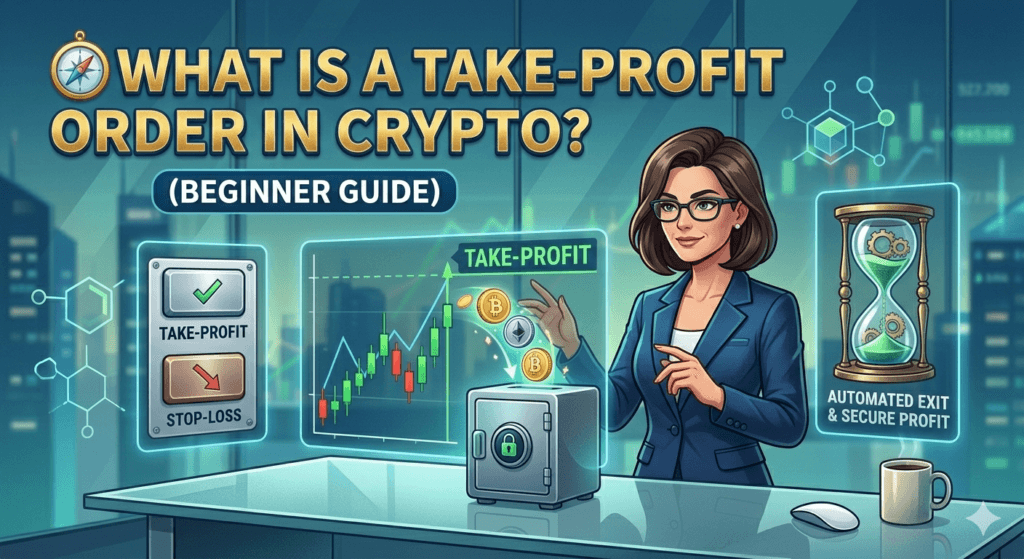
A visual guide showing how a take-profit order in crypto helps traders lock in profits automatically at a target price.
 What Is a Take-Profit Order in Crypto?
 What Is a Take-Profit Order in Crypto?
A take-profit order in crypto is an instruction to automatically close a trade when the price reaches a predefined profit level.
 In simple terms:
It helps you secure your profits before the market reverses.
Example of a Take-Profit Order
 Example of a Take-Profit Order
- You buy Bitcoin at $76,000
- You set a take-profit at $79,000
If the price reaches $79,000, your position is automatically closed, locking in your profit.
How Does a Take-Profit Order Work?
 How Does a Take-Profit Order Work?
A take-profit order works similarly to a limit order.
It has two key elements:
- Target Price → The level where you want to exit
- Execution → Order is placed automatically when price is reached
This removes the need to manually monitor the market.
Why Take-Profit Orders Are Important
 Why Take-Profit Orders Are Important
Crypto markets are volatile.
Without a take-profit:
- You may hold too long
- Profits can turn into losses
- Emotions can affect decisions
A take-profit order helps you:
- Lock in gains
- Stay disciplined
- Follow your trading plan
Market conditions like slippage can impact execution. Read our guide on slippage in crypto trading.
Take-Profit vs Stop-Loss
 Take-Profit vs Stop-Loss
| Feature | Take-Profit | Stop-Loss |
|---|---|---|
| Purpose | Lock profits | Limit losses |
| Trigger | Price goes up | Price goes down |
| Emotion control | High | High |
Together, they form a complete risk management strategy. A combination of take-profit and stop-loss orders is the foundation of strong risk management in crypto trading.
When Should You Use a Take-Profit Order?
 When Should You Use a Take-Profit Order?
Use a take-profit when:
- You have a predefined target
- You can’t monitor the market constantly
- You want to avoid emotional decisions
- You follow a trading strategy
Types of Take-Profit Strategies
 Types of Take-Profit Strategies
 Fixed Price Target
 Fixed Price Target
Set a fixed level based on your profit goal.
Resistance Level Strategy
Place take-profit near key resistance levels.
Risk-to-Reward Based Target
Use a ratio like 1:2 or 1:3 to decide exit points. Not sure whether to invest all at once or gradually? Read our guide on lump sum vs dollar cost averaging.
Common Mistakes to Avoid
 Common Mistakes to Avoid
- Setting unrealistic targets
- Not using take-profit at all
- Ignoring market conditions
- Closing trades too early due to fear
Tools to Improve Your Trading
 Tools to Improve Your Trading
 Use tools to plan better trades:
- Track performance with ROI Calculator
- Plan investments using DCA Calculator
- Compare exchange fees before trading
Related Concepts You Should Know
 Related Concepts You Should Know
 Understanding these will improve your trading:
- Stop-loss orders
- Limit vs market orders
- Slippage in crypto trading
Security Tip
 Security Tip
After securing profits: Don’t leave all funds on exchanges
Use best hardware wallets for long-term storage.
Final Thoughts
 Final Thoughts
A take-profit order is one of the simplest yet most powerful tools in crypto trading. It helps you:
- Lock in profits
- Stay disciplined
- Avoid emotional mistakes
The best traders don’t just know when to enter – they know when to exit too.
Key Takeaways
- A take-profit order in crypto helps you automatically lock in profits at a predefined price.
- It removes emotional decision-making and ensures disciplined trading.
- Take-profit orders work best when combined with stop-loss orders.
- Setting realistic profit targets improves long-term trading success.
- Using proper strategies like resistance levels and risk-reward ratios enhances outcomes.
Frequently Asked Questions (FAQ)
1. What is a take-profit order in crypto?
A take-profit order in crypto is an automatic instruction to close a trade when the price reaches a specified profit level.
2. How does a take-profit order work?
It executes a sell order when the market reaches your target price, helping you secure profits without manual intervention.
3. What is the difference between take-profit and stop-loss?
A take-profit locks in gains when the price rises, while a stop-loss limits losses when the price falls.
4. Should beginners use take-profit orders?
Yes, take-profit orders help beginners avoid emotional trading and ensure profits are secured based on a plan.
5. Can a take-profit order guarantee exact profits?
Not always. Market conditions and slippage can cause slight variations in execution price.