
Crypto trading offers different ways to buy and sell assets. Two of the most common order types are market orders and limit orders. Understanding the difference between them is essential for managing risk, controlling price, and improving your trading results. In this guide, we’ll explain limit order vs market order in crypto in simple terms, with examples, advantages, and when to use each.
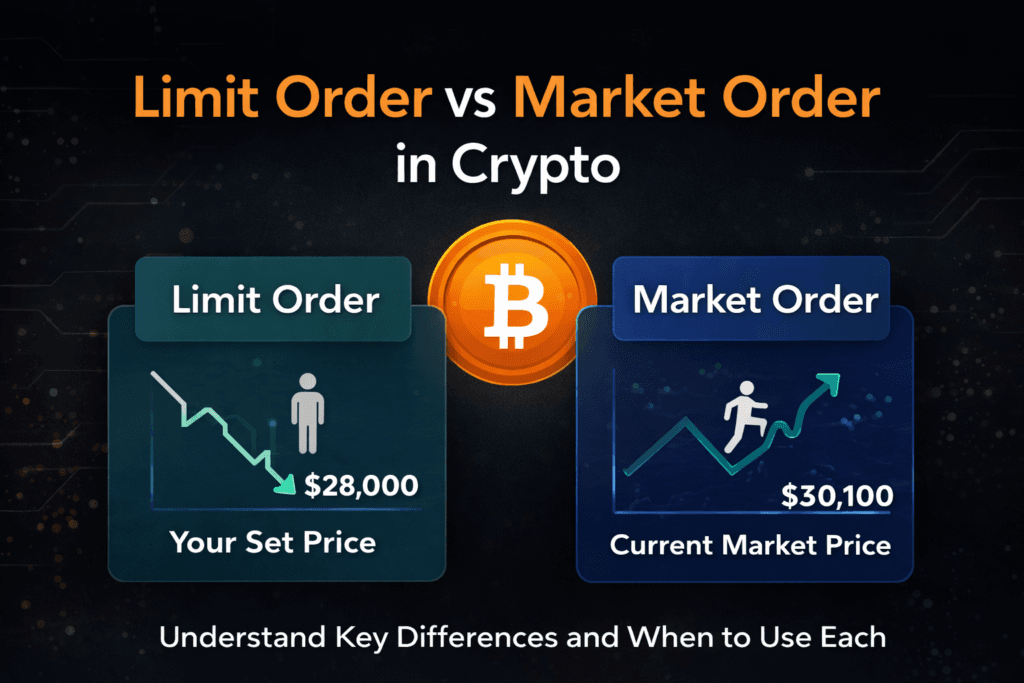
What Is a Market Order in Crypto?
A market order is an order to buy or sell a cryptocurrency immediately at the best available price.
 In simple terms:
You accept the current market price to complete the trade instantly.
Example of a Market Order
- Bitcoin is trading at $30,000
- You place a market buy order
Your order executes immediately at the closest available price (e.g., $30,050)
Advantages of Market Orders
- Instant execution
- Useful in fast-moving markets
- Simple and beginner-friendly
Disadvantages of Market Orders
- No control over final price
- Higher risk of slippage in crypto trading
- Not ideal for large trades
What Is a Limit Order in Crypto?
A limit order is an order to buy or sell a cryptocurrency at a specific price you choose.
In simple terms:
You set the price, and the trade only happens if the market reaches it.
Example of a Limit Order
- Bitcoin is trading at $30,000
- You place a limit buy order at $29,000
Your order will only execute if the price drops to $29,000
Advantages of Limit Orders
- Full control over price
- Helps reduce slippage
- Better for planned entries and exits
Disadvantages of Limit Orders
- May not execute
- Slower than market orders
- Requires more patience
Limit Order vs Market Order: Key Differences
| Feature | Market Order | Limit Order |
|---|---|---|
| Execution | Instant | Only at set price |
| Price Control | No | Yes |
| Slippage Risk | High | Low |
| Speed | Fast | Depends on market |
| Best For | Quick trades | Planned trades |
When Should You Use a Market Order?
Market orders are best when:
- You want to enter or exit quickly
- The market is moving fast
- You are trading small amounts
However, always be cautious of price changes.
When Should You Use a Limit Order?
Limit orders are ideal when:
- You want a specific entry or exit price
- You are trading large amounts
- You want to reduce trading costs
They are commonly used by experienced traders.
How Order Types Affect Your Profit
The type of order you choose directly impacts your returns.
- Market orders may lead to higher costs due to slippage
- Limit orders help you control entry and exit points
Even small differences in execution price can affect long-term profits.
Tools to Improve Your Trading Decisions
Understanding order types is just one part of successful crypto investing.
Below steps and tools needs to be used too:
- Use our Crypto ROI Calculator to track your overall returns
- Use our DCA Calculator to plan long-term investments
- Use our Wealth Goal Calculator to estimate growth potential
Choosing the Right Exchange Matters
Execution quality depends heavily on the exchange you use.
“Using high-liquidity exchanges can improve order execution and reduce slippage.”
Here are some of the top exchanges you may use:
- Binance
- KuCoin
- WazirX
- Pionex
- TradeSanta (Crypto BOT)
Security Tip: Protect Your Assets
After trading, securing your funds is essential.
“For long-term storage, consider using the best hardware wallet to protect your crypto assets.”
Final Thoughts
Both limit and market orders play an important role in crypto trading.
- Market orders offer speed
- Limit orders offer control
The right choice depends on your trading strategy, risk tolerance, and market conditions. By understanding how each works, you can make smarter decisions and improve your overall trading performance.
Key Takeaways
- Limit order vs market order in crypto refers to two different ways of executing trades.
- A market order executes instantly at the best available price.
- A limit order executes only at a specific price set by the trader.
- Market orders are faster but can lead to slippage in volatile markets.
- Limit orders provide better price control but may not always execute.
Frequently Asked Questions (FAQ)
1. What is the difference between limit order and market order in crypto?
A market order executes immediately at the current market price, while a limit order only executes at a specific price set by the trader.
2. Which is better: limit order or market order?
It depends on your goal. Market orders are better for quick execution, while limit orders are better for price control.
3. Do market orders have slippage?
Yes, market orders can experience slippage, especially in volatile or low-liquidity markets.
4. Can a limit order fail to execute?
Yes, if the market price does not reach your specified price, the limit order will not be executed.
5. When should I use a limit order in crypto?
You should use a limit order when you want to buy or sell at a specific price and are willing to wait for the market to reach that level.