
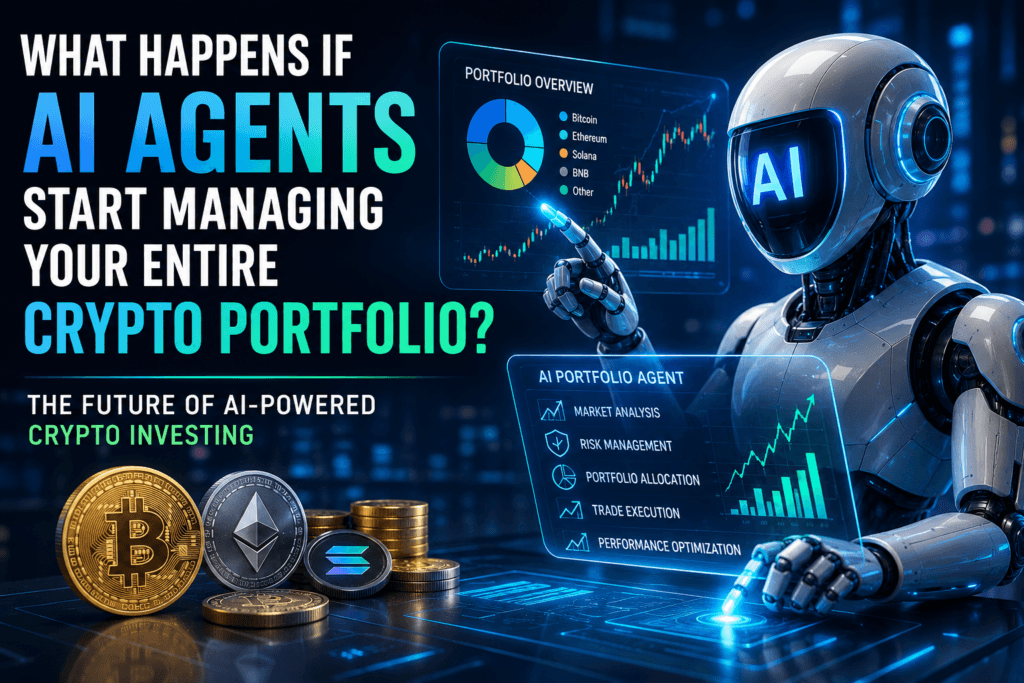
AI crypto portfolio management is rapidly evolving from a futuristic concept into a realistic possibility. For years, cryptocurrency investors have personally handled most aspects of portfolio management, including:
- Researching coins
- Monitoring markets
- Executing trades
- Managing risk
- Rebalancing portfolios
However, advances in artificial intelligence are creating a new possibility. What if intelligent AI agents could handle these responsibilities automatically? As AI technology becomes increasingly sophisticated, many investors are beginning to ask a fascinating question:
What happens if AI agents start managing your entire crypto portfolio?
In 2026, AI is already being used across trading, portfolio analytics, risk assessment, and market forecasting. Consequently, fully autonomous AI portfolio managers may become one of the most significant developments in digital finance over the next decade.
AI agents could transform crypto investing by automating research, risk management, portfolio allocation, and trading decisions on behalf of investors.
While this future offers exciting possibilities, it also introduces important questions about trust, transparency, accountability, and financial control. AI-powered portfolio managers could change how investors interact with cryptocurrency by automating complex financial decisions and reducing emotional investing.
Why Portfolio Management Matters
Successful investing involves much more than simply buying assets. Investors must regularly:
- Research opportunities
- Manage risk
- Monitor performance
- Rebalance holdings
- Adjust strategies
Unfortunately, many retail investors struggle to consistently perform these tasks. As a result, emotional decision-making often leads to poor outcomes, including:
- Panic selling
- FOMO buying
- Overtrading
- Poor diversification
- Excessive risk-taking
Consequently, many investors seek tools that can improve discipline and consistency.
What Is An AI Agent?
An AI agent is an autonomous software system capable of making decisions, performing tasks, and adapting to changing conditions with minimal human intervention. Unlike traditional trading bots that follow fixed rules, advanced AI agents may:
- Analyze market data
- Learn from past outcomes
- Adapt strategies
- Manage portfolios
- Execute transactions
Furthermore, future AI agents may continuously improve their performance by learning from vast amounts of financial information.
How AI Is Already Being Used In Crypto
Artificial intelligence is already influencing cryptocurrency markets in several ways. Current applications include:
- Market analysis
- Sentiment tracking
- Trading automation
- Fraud detection
- Risk management
Additionally, AI-powered tools increasingly help investors identify trends that would be difficult for humans to recognize manually. As AI technology improves, these capabilities are becoming more advanced and accessible.
What Could AI Portfolio Managers Do?
Future AI agents may be capable of managing nearly every aspect of an investment portfolio. Potential responsibilities include:
- Asset selection
- Portfolio allocation
- Rebalancing
- Risk management
- Trade execution
Instead of manually monitoring markets every day, investors could simply define objectives while AI handles ongoing portfolio management. Consequently, investing may become significantly more automated than it is today.
Can AI Agents Connect To Crypto Exchanges?
Most AI portfolio management systems still require access to cryptocurrency exchanges in order to execute trades, rebalance portfolios, and manage digital assets automatically.
Popular exchanges commonly used with automated trading systems include:
As AI-powered investing continues to evolve, the connection between portfolio management software and crypto exchanges may become increasingly important for investors seeking automation.
Eliminating Emotional Investing
One of the largest advantages of AI portfolio management could be the removal of emotional decision-making. Human investors often react emotionally to:
- Market crashes
- Sudden rallies
- Social media hype
- Fear and uncertainty
- Short-term volatility
AI agents, however, do not experience fear or greed. As a result, they may consistently follow predefined investment strategies regardless of market conditions. For many investors, this could represent a major improvement over emotionally driven investing.
Personalized Investment Strategies
Future AI systems may create highly customized portfolios based on individual preferences. For example, AI could optimize investments according to:
- Risk tolerance
- Investment goals
- Income requirements
- Time horizons
- Market outlook
Furthermore, AI agents could continuously adjust strategies as personal circumstances evolve. Consequently, portfolio management may become far more personalized than traditional investment services.
Continuous Market Monitoring
Cryptocurrency markets operate 24 hours a day, seven days a week. Unlike human investors, AI systems never need to sleep. Therefore, AI agents could continuously:
- Monitor prices
- Analyze news
- Track market sentiment
- Evaluate risks
- Identify opportunities
This constant vigilance could potentially improve response times during rapidly changing market conditions. As a result, investors may benefit from around-the-clock portfolio oversight.
Risk Management Could Improve
Risk management remains one of the most important aspects of investing. AI agents may help investors by:
- Limiting exposure
- Diversifying portfolios
- Reducing concentration risk
- Identifying market threats
- Adjusting allocations automatically
Additionally, AI systems could potentially react to emerging risks faster than human investors.Consequently, portfolio volatility may become easier to manage.
The Rise Of Agentic Finance
Some industry observers believe we are entering an era of “agentic finance.”
In this model, AI agents could autonomously:
- Manage investments
- Pay bills
- Optimize savings
- Allocate assets
- Execute financial plans
Rather than acting as passive tools, AI systems would become active participants in financial decision-making. As artificial intelligence continues advancing, this vision is becoming increasingly realistic. The emergence of autonomous financial agents is already reshaping how digital assets are managed.
Potential Benefits For Investors
AI portfolio management could offer several significant advantages. Potential benefits include:
- Reduced emotional investing
- Improved efficiency
- Faster decision-making
- Continuous monitoring
- Personalized strategies
Furthermore, AI may make sophisticated portfolio management accessible to individuals who previously lacked access to professional financial services. As a result, investment opportunities could become more widely available.
Security And Trust Challenges
Despite the potential benefits, important concerns remain. Investors may worry about:
- Security vulnerabilities
- AI errors
- Software failures
- Data privacy
- Unauthorized transactions
Additionally, giving AI control over financial assets requires a high level of trust. Therefore, security infrastructure will likely play a critical role in determining adoption.
Who Is Responsible If AI Makes A Mistake?
One of the biggest questions surrounding autonomous finance involves accountability.
For example:
- Who is responsible if AI loses money?
- Who determines acceptable risk levels?
- Who audits AI decisions?
- Who protects investors from flawed algorithms?
These questions remain largely unresolved. Consequently, regulators may face significant challenges as AI-driven investing expands.
Could AI Outperform Human Investors?
Many studies suggest that human investors often underperform because of emotional behavior and inconsistent decision-making. AI agents may potentially outperform some investors by:
- Processing more data
- Removing emotions
- Maintaining discipline
- Operating continuously
- Adapting rapidly
However, outperforming markets consistently remains extremely difficult. Therefore, AI should not be viewed as a guaranteed path to investment success.
What Could 2030 Look Like?
By 2030, investors may have access to highly advanced AI financial assistants. Future AI agents could potentially:
- Build portfolios automatically
- Execute trades
- Optimize taxes
- Manage risk
- Rebalance investments continuously
Investors might simply establish goals while AI handles day-to-day financial operations. As a result, portfolio management could become significantly more automated than it is today.
Will Humans Still Control Their Investments?
Most likely, yes.
Even as AI becomes more capable, many investors will likely prefer maintaining some level of human oversight. Future systems may operate using hybrid models that combine:
- Human supervision
- AI analysis
- Automated execution
- Risk controls
- Personalized objectives
Consequently, investors may benefit from AI assistance while retaining ultimate control over important financial decisions.
Final Thoughts
The idea of AI agents managing entire crypto portfolios may sound futuristic, but many of the underlying technologies already exist today.
Supporters believe:
- AI reduces emotional investing
- Portfolio management becomes more efficient
- Risk management improves
- Financial services become more accessible
Critics, however, argue:
- Trust remains a major obstacle
- Security risks still exist
- Accountability is unclear
- Human judgment remains important
In 2026, fully autonomous AI portfolio management remains in its early stages. Nevertheless, as artificial intelligence continues advancing, AI agents may become increasingly influential participants in the future of cryptocurrency investing.
Key Takeaways
- AI crypto portfolio management could automate research, trading, portfolio allocation, and risk management for investors.
- Unlike traditional trading bots, advanced AI agents may continuously learn, adapt, and improve their decision-making over time.
- AI systems could help reduce emotional investing by removing fear, greed, panic selling, and FOMO-driven decisions.
- Future AI agents may provide highly personalized investment strategies based on risk tolerance, goals, and market conditions.
- Continuous 24/7 market monitoring could allow AI to react faster than human investors to changing market conditions.
- Improved risk management may become one of the biggest advantages of AI-managed crypto portfolios.
- Important concerns remain regarding security, accountability, privacy, and trust in autonomous financial systems.
- By 2030, many investors may use hybrid systems that combine AI automation with human oversight and control.
Frequently Asked Questions (FAQ)
What is an AI crypto portfolio manager?
An AI crypto portfolio manager is an automated system that uses artificial intelligence to analyze markets, manage investments, rebalance portfolios, and execute trading decisions on behalf of investors.
How is an AI agent different from a trading bot?
Traditional trading bots follow fixed rules, while AI agents can learn from data, adapt strategies, evaluate changing market conditions, and improve decision-making over time.
Can AI eliminate emotional investing?
AI does not experience fear, greed, panic, or FOMO. As a result, AI systems may help investors avoid many of the emotional mistakes that often reduce investment performance.
Could AI outperform human crypto investors?
AI may outperform some investors by processing more information, operating continuously, and maintaining discipline. However, consistent market outperformance is never guaranteed.
What are the biggest risks of AI-managed portfolios?
Key risks include software failures, security vulnerabilities, poor decision-making, data privacy concerns, and uncertainty regarding accountability when mistakes occur.
Will AI completely replace human investors?
Most experts believe AI will assist rather than fully replace investors. Hybrid models combining AI automation with human oversight are considered the most likely outcome.
Could AI manage an entire crypto portfolio by 2030?
It is possible. As artificial intelligence and blockchain technology continue advancing, AI agents may increasingly handle portfolio management, risk assessment, and investment allocation tasks.