
For millions of people around the world, traditional financial systems no longer feel as stable or trustworthy as they once did. Rising inflation, banking risks, geopolitical tensions, and debt concerns are forcing many individuals to rethink how they protect their money. Many are also reconsidering how they secure their future wealth. As a result, the idea of using Bitcoin as a Bitcoin Plan B asset is gaining momentum globally. For some people, Bitcoin is no longer viewed simply as a speculative investment. Instead, it is increasingly becoming:
🔐 a financial backup plan
🌍 a hedge against instability
⚡ an alternative monetary system
🛡 a tool for financial independence
In 2026, this shift is accelerating faster than ever before.
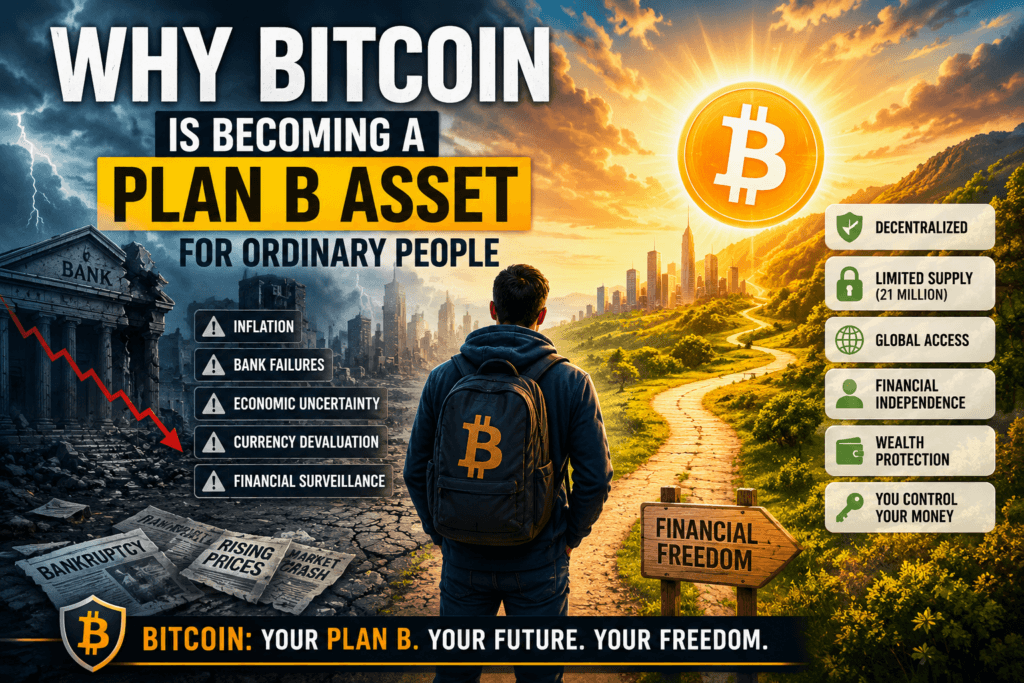
🌍 Why More People Are Losing Trust In Traditional Systems
For decades, many people depended entirely on:
🏦 banks
💵 fiat currencies
📈 stock markets
🏛 government-controlled financial systems
However, in recent years, several vulnerabilities inside the global economy have been increasingly visible.
People around the world are increasingly concerned about:
⚠ inflation reducing purchasing power
⚠ rising national debt
⚠ banking instability
⚠ currency devaluation
⚠ geopolitical uncertainty
⚠ stricter financial surveillance
For ordinary households, these risks are becoming more visible in daily life through:
✔ higher living costs
✔ weaker savings value
✔ uncertain retirement planning
✔ growing financial anxiety
As confidence weakens, many individuals are therefore searching for alternative ways to preserve wealth outside traditional systems.
₿ Why Bitcoin Appeals To Ordinary People
Bitcoin offers several characteristics that attract individuals seeking financial protection and independence.
Unlike traditional currencies, Bitcoin operates globally through decentralized infrastructure. It also functions without central banks and maintains a fixed supply limit.
🌍 globally
⚡ without central banks
🔐 through decentralized infrastructure
📉 with a fixed supply limit (Bitcoin whitepaper)
Many supporters believe these features make Bitcoin attractive during periods of:
✔ inflation (BTC vs GOLD)
✔ monetary expansion
✔ banking uncertainty
✔ political instability
As a result, for some users, Bitcoin represents:
💰 digital scarcity
🛡 protection against currency debasement
🌐 borderless wealth storage
⚡ long-term financial optionality
Consequently, Bitcoin is increasingly viewed as a “Plan B” asset rather than simply a high-risk trade.
🏦 Banking Crises Have Changed Public Perception
Several banking failures and financial crises have strengthened Bitcoin’s narrative as an alternative financial system. This trend has accelerated over the past decade and have pushed more individuals to consider assets they can control independently.
Events involving:
🏦 frozen withdrawals
⚠ capital controls
📉 bank collapses
🌍 sanctions
💵 currency restrictions
Additionally, many Bitcoin supporters argue self-custody offers an important advantage during periods of financial instability because users can:
✔ hold assets directly
✔ move wealth globally
✔ reduce dependence on intermediaries
✔ maintain financial access independently
This growing interest in self-sovereign finance continues expanding globally.
🌐 Bitcoin As A Global Financial Escape Valve
One reason Bitcoin’s adoption continues spreading worldwide is its accessibility.
Unlike many traditional financial assets, Bitcoin can often be accessed by:
🌍 people in unstable economies
📱 mobile-first users
🏦 individuals without full banking access
⚡ global freelancers and remote workers
In countries facing:
⚠ high inflation
⚠ weak banking systems
⚠ strict capital controls
⚠ political instability
Bitcoin sometimes becomes more than an investment.
For some individuals, it becomes:
🔐 savings protection
💱 cross-border liquidity
🌍 financial mobility
🛡 economic survival infrastructure
This “Plan B” narrative has become especially strong in emerging markets and economically unstable regions.
🤖 Younger Generations Think Differently About Money
Meanwhile, another major factor driving Bitcoin adoption is generational change.
Many younger investors increasingly question traditional assumptions around:
🏦 banking systems
📈 retirement models
💵 fiat currency stability
🏠 home ownership affordability
Digital-native generations are often more comfortable with:
📱 online financial systems
🌐 decentralized technologies
⚡ digital assets
🤖 fintech innovation
For these users, Bitcoin may feel more aligned with the future digital economy than traditional financial infrastructure.
As a result, younger generations increasingly view Bitcoin as:
✔ long-term savings technology
✔ portfolio diversification
✔ financial independence tool
✔ alternative economic insurance
⚖ Bitcoin Still Carries Significant Risks
Nevertheless, despite its growing popularity, Bitcoin remains highly volatile and risky.
Price swings can remain extreme, and investors still face:
⚠ market crashes
⚠ regulatory uncertainty
⚠ security risks
⚠ emotional volatility
⚠ long-term adoption uncertainty
Critics also argue Bitcoin may still struggle with:
📉 scalability challenges
🌍 regulatory pressure
⚡ energy consumption debates
🏦 institutional influence
Because of these risks, many financial experts still recommend cautious portfolio management and risk awareness when investing in crypto assets.
🔐 Self-Custody Is Becoming Increasingly Important
Furthermore, as more people adopt Bitcoin as a backup financial system, self-custody is becoming a growing priority.
Many users increasingly prefer:
🔐 hardware wallets
🛡 cold storage
⚡ private key ownership
🌍 decentralized asset control
This trend accelerated after several crypto exchange failures highlighted the risks of leaving assets fully dependent on third parties.
The phrase: “Not your keys, not your coins.”
continues becoming one of the most repeated principles inside the Bitcoin community.
📚 Final Thoughts
Bitcoin’s role inside the global financial system continues evolving rapidly.
For some people, Bitcoin remains a speculative asset. For others, however, it is increasingly becoming:
🔐 a financial backup plan
🌍 an alternative monetary network
🛡 protection against instability
⚡ a tool for financial sovereignty
As inflation concerns, geopolitical uncertainty, digital financial surveillance, and economic instability continue shaping the world economy, more ordinary people may continue viewing Bitcoin as a “Plan B” asset for the future.
Whether Bitcoin ultimately fulfills that role long term remains uncertain. But in 2026, the shift in perception is already becoming impossible to ignore.
Key Takeaways
- Bitcoin is increasingly being viewed as a “Plan B” asset by ordinary people seeking financial protection and independence.
- Rising inflation, banking instability, and geopolitical uncertainty are weakening trust in traditional financial systems.
- Bitcoin’s decentralized structure, fixed supply, and global accessibility attract users looking for alternative wealth protection.
- Banking crises and financial restrictions have strengthened interest in self-custody and financial sovereignty.
- Younger generations are becoming more comfortable with digital assets and decentralized financial systems.
- Despite its growing adoption, Bitcoin still carries major risks including volatility, regulation, and market uncertainty.
- Self-custody and hardware wallets are becoming increasingly important for long-term Bitcoin holders.
Frequently Asked Questions (FAQ)
Why is Bitcoin called a “Plan B” asset?
Bitcoin is increasingly called a “Plan B” asset because many people view it as an alternative financial system outside traditional banks and government-controlled currencies.
Why are ordinary people buying Bitcoin in 2026?
Many people are turning to Bitcoin due to inflation concerns, banking instability, geopolitical uncertainty, and growing interest in financial independence.
How does Bitcoin protect against inflation?
Bitcoin has a fixed maximum supply of 21 million coins, which supporters believe makes it resistant to currency debasement caused by excessive money printing.
What is self-custody in Bitcoin?
Self-custody means users personally control their Bitcoin using private keys instead of relying on centralized exchanges or third parties.
Is Bitcoin still risky in 2026?
Yes. Bitcoin remains highly volatile and investors still face risks related to regulation, security, market crashes, and long-term adoption uncertainty.
Why do younger generations prefer Bitcoin?
Many younger investors are more comfortable with digital financial systems and decentralized technologies compared to traditional banking infrastructure.
Can Bitcoin replace traditional banking systems?
Bitcoin may not fully replace banks, but many supporters believe it can serve as an alternative financial network for savings, payments, and wealth protection.