
The stablecoin economy is rapidly reshaping global finance as digital dollars like USDT and USDC increasingly power blockchain payments, cross-border transfers, tokenized assets, and institutional financial infrastructure in 2026.
For decades, traditional finance relied heavily on:
🏦 banks
💵 physical cash
🌍 international wire systems
📄 slow settlement networks
But in 2026, the stablecoin economy is rapidly becoming one of the biggest forces quietly reshaping global finance.
Today, blockchain-based digital dollars are increasingly being used to:
✔ transfer money globally
✔ settle crypto trades
✔ move capital quickly
✔ access decentralized finance
✔ power tokenized financial systems
As stablecoin adoption grows worldwide, many analysts now believe digital dollars may become one of the most important financial innovations of the modern blockchain era.
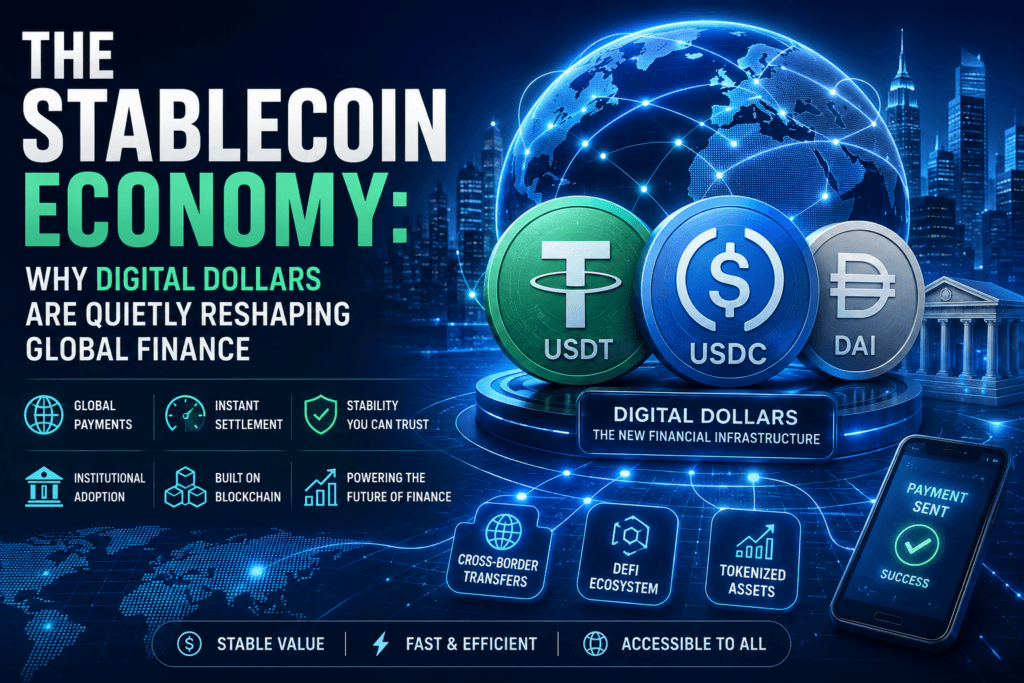
🌍 What Is The Stablecoin Economy?
The stablecoin economy refers to the growing financial ecosystem built around blockchain-based digital currencies that are designed to maintain stable value.
Most stablecoins are linked to:
💵 US Dollar
💶 Euro
🏦 fiat reserves
📄 treasury assets
Unlike highly volatile cryptocurrencies, stablecoins aim to maintain price stability while still operating on blockchain infrastructure.
Some of the largest stablecoins today include:
💵 USDT (Tether)
💵 USDC (USD Coin)
💵 DAI
💵 FDUSD
These digital dollars are increasingly being used across:
🌍 global payments
⚡ crypto trading
🏦 decentralized finance
📄 tokenized assets
💰 cross-border transfers
⚡ Why Stablecoins Are Growing So Fast
Stablecoins solve several major problems inside both traditional finance and crypto markets.
Traditional international banking systems often involve:
⚠ slow transfers
⚠ high fees
⚠ banking restrictions
⚠ settlement delays
⚠ limited accessibility
Stablecoins allow users to:
✔ transfer funds globally within minutes
✔ move money 24/7
✔ avoid some banking limitations
✔ access digital finance more easily
✔ reduce volatility exposure inside crypto markets
For many users in high-inflation economies, stablecoins also provide access to digital dollar exposure without relying entirely on local banking systems.
This is one reason why stablecoin adoption has expanded rapidly worldwide. Millions of users now buy, transfer, and store stablecoins through major crypto exchanges (Binance, Kucoin, Wazirx and Pionex etc.) and trading platforms.
🏦 Why Institutions Are Paying Attention To Stablecoins
Stablecoins are no longer viewed only as crypto trading tools.
In 2026, institutions increasingly view stablecoins as:
🏛 financial infrastructure
⚡ settlement technology
🌍 cross-border payment rails
📄 programmable money
Many financial firms believe stablecoins could eventually improve:
✔ payment efficiency
✔ global settlement speed
✔ financial accessibility
✔ liquidity movement
✔ tokenized asset infrastructure
This is one reason major banks, fintech companies, and payment providers are increasingly exploring blockchain settlement systems.
💵 Stablecoins And The Rise Of Tokenized Finance
One of the biggest reasons stablecoins are becoming important is their role inside the rapidly growing tokenization economy.
Stablecoins are increasingly being used to support:
🏗 tokenized assets
🏢 tokenized real estate
📄 blockchain-based bonds
🏦 on-chain financial products
🌍 digital investment markets
Because stablecoins maintain relatively stable value, they function as an important bridge between:
🏦 traditional finance
and
🌐 blockchain finance
This is helping accelerate the growth of:
⚡ Real-World Asset (RWA) tokenization
🏛 Institutional blockchain adoption
🌍 Programmable finance systems
🔐 Stablecoins vs CBDCs: What’s The Difference?
As governments explore Central Bank Digital Currencies (CBDCs), many experts compare them with stablecoins.
While both involve digital currencies, they operate very differently.
Stablecoins are generally:
✔ privately issued
✔ blockchain-based
✔ globally accessible
✔ integrated into crypto ecosystems
CBDCs, however, are typically:
🏦 government-controlled
📄 centrally managed
⚖ tied to national monetary systems
👁 potentially more monitored
Supporters of stablecoins argue they may offer:
🔐 more flexibility
🌍 broader accessibility
⚡ faster innovation
Critics argue stablecoins may still face:
⚠ regulatory risk
⚠ reserve concerns
⚠ centralized issuer control
The relationship between stablecoins and CBDCs may become one of the defining financial debates of the next decade.
⚠️ Risks Facing The Stablecoin Economy
Despite rapid growth, stablecoins still face important challenges.
These include:
⚠ regulation uncertainty
⚠ reserve transparency concerns
⚠ depegging risk
⚠ centralized control
⚠ compliance pressure
⚠ cybersecurity threats
Governments around the world are increasingly discussing:
🏛 stablecoin regulation
📄 reserve requirements
⚖ compliance rules
🌍 international oversight
Critics worry excessive regulation could:
⚠ limit innovation
⚠ reduce decentralization
⚠ increase financial surveillance
At the same time, supporters argue stronger oversight may improve:
✔ stability
✔ institutional trust
✔ mainstream adoption
🌐 Why Ethereum Plays A Major Role
Much of the stablecoin economy currently operates on:
⚡ Ethereum infrastructure
Ethereum remains one of the largest blockchain settlement networks supporting:
💵 USDT (Tether)
💵 USDC (USD Coin)
🏗 tokenized assets
📄 decentralized finance
🌍 smart contract applications
Because Ethereum allows programmable transactions, many institutions view it as:
🏛 financial infrastructure
⚡ a settlement layer
🌍 blockchain payment rails
This connection between Ethereum and stablecoins is becoming increasingly important inside institutional finance discussions.
📱 Stablecoins May Quietly Reshape Everyday Finance
Many people still associate crypto primarily with:
📈 speculation
🪙 volatile assets
⚡ meme coins
However, stablecoins are increasingly focused on real-world financial utility.
In future years, stablecoins may increasingly power:
🌍 international commerce
📱 mobile payments
🏦 digital banking
⚡ instant settlement
🤖 tokenized finance ecosystems
Some analysts believe many users may eventually interact with blockchain finance daily without even realizing stablecoins are operating behind the scenes.
📚 Final Thoughts
The stablecoin economy is rapidly becoming one of the most important developments shaping the future of global finance.
As blockchain infrastructure expands and tokenized finance grows, stablecoins are increasingly functioning as:
🏛 digital dollars
⚡ settlement infrastructure
🌍 global payment rails
📄 programmable financial tools
Supporters believe stablecoins could eventually modernize large parts of the global financial system through:
✔ faster payments
✔ lower costs
✔ global accessibility
✔ blockchain efficiency
Critics, however, continue raising concerns around:
⚠ regulation
⚠ centralization
⚠ reserve transparency
⚠ financial oversight
In 2026, the stablecoin economy remains one of the fastest-growing sectors in digital finance and its long-term impact on banking, payments, and global commerce may only be beginning.
Key Takeaways
- The stablecoin economy is rapidly transforming global finance through blockchain-based digital dollars.
- Stablecoins like USDT and USDC are increasingly used for payments, trading, DeFi, and tokenized assets.
- Institutions are exploring stablecoins for faster settlement, global transfers, and programmable finance.
- Stablecoins are becoming important infrastructure for Real-World Asset (RWA) tokenization and blockchain finance.
- Ethereum remains one of the largest networks supporting stablecoin transactions and tokenized financial systems.
- Stablecoins offer benefits such as lower costs, 24/7 transfers, and global accessibility compared to traditional banking.
- Regulation, reserve transparency, and centralization remain major challenges facing the stablecoin industry.
- The future of digital finance may increasingly depend on stablecoins powering global blockchain-based payment systems.
Frequently Asked Questions (FAQ)
What is the stablecoin economy?
The stablecoin economy refers to the growing financial ecosystem built around blockchain-based digital currencies designed to maintain stable value, usually linked to fiat currencies like the US Dollar.
Why are stablecoins becoming popular?
Stablecoins are growing because they allow faster global transfers, lower transaction costs, 24/7 accessibility, and reduced volatility compared to many cryptocurrencies.
What are the most popular stablecoins?
Some of the largest stablecoins include USDT (Tether), USDC (USD Coin), DAI, and FDUSD.
How do stablecoins help global finance?
Stablecoins help improve settlement speed, cross-border payments, tokenized asset infrastructure, and blockchain-based financial services.
What is the difference between stablecoins and CBDCs?
Stablecoins are typically privately issued blockchain-based digital currencies, while CBDCs are government-controlled digital currencies issued by central banks.
Why is Ethereum important for stablecoins?
Ethereum supports a large portion of stablecoin activity through smart contracts, decentralized finance applications, and tokenized financial infrastructure.
What risks does the stablecoin economy face?
Major risks include regulation uncertainty, reserve transparency concerns, depegging events, cybersecurity threats, and centralized issuer control.
Could stablecoins reshape the future of finance?
Many experts believe stablecoins could modernize global finance through faster payments, lower costs, tokenized assets, and programmable blockchain-based financial systems.