
Bitcoin mining rewards are one of the most important mechanisms that keep the Bitcoin network secure and operational. For over a decade, miners have been rewarded with newly created Bitcoin for validating transactions and maintaining the blockchain.
However, Bitcoin was designed with a fixed supply of 21 million coins. As a result, mining rewards are programmed to decrease over time through a process known as the Bitcoin halving. This has led many investors to ask an important question:
👉 What happens when Bitcoin mining rewards become too small?
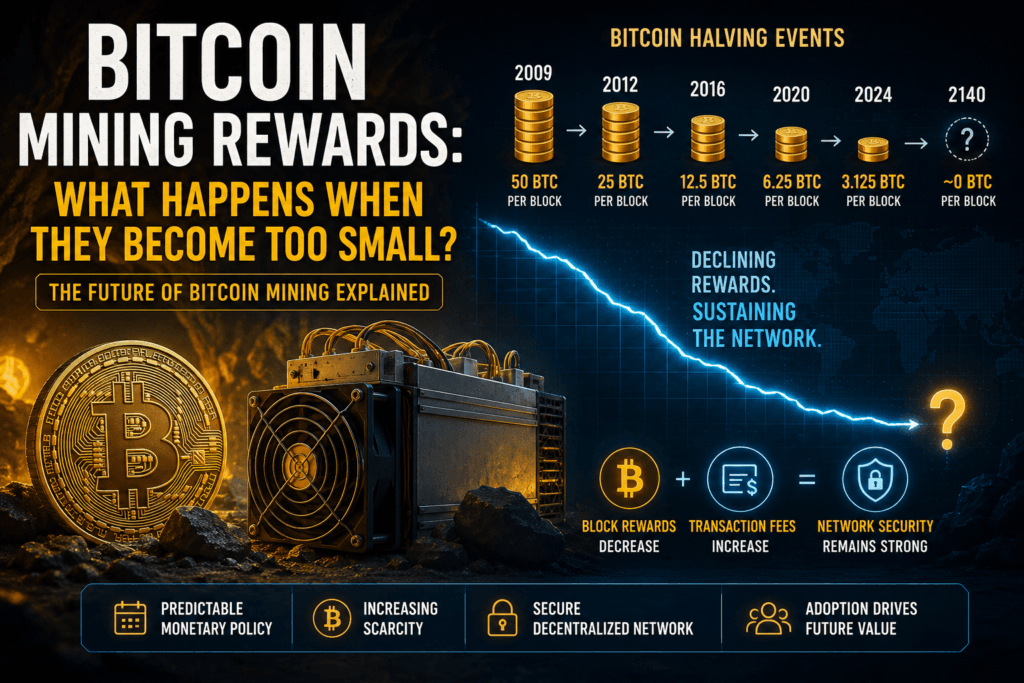
In 2026, this question is becoming increasingly relevant as each halving reduces the amount of new Bitcoin entering circulation. While Bitcoin’s scarcity is one of its greatest strengths, some critics wonder whether the network can remain secure when miners earn fewer newly issued coins. Bitcoin mining rewards illustration showing Bitcoin miners, blockchain security, transaction fees, halving events, declining block rewards, and the future of Bitcoin mining after 2026.
Bitcoin mining rewards play a critical role in securing the Bitcoin network, but future halvings will gradually reduce new coin issuance and shift miner incentives toward transaction fees.
⛏ What Are Bitcoin Mining Rewards?
Bitcoin miners perform the computational work required to verify transactions and add new blocks to the blockchain. In return, miners receive:
✔ Newly created Bitcoin
✔ Transaction fees from users
✔ Incentives for securing the network
This reward system helps ensure that miners continue contributing computing power to maintain Bitcoin’s decentralized infrastructure. Without mining rewards, there would be far less incentive for miners to participate.
📉 Why Mining Rewards Keep Declining
Bitcoin’s creator, Satoshi Nakamoto, designed the network with a predictable monetary policy. Approximately every four years:
⚡ Mining rewards are cut in half
⚡ New Bitcoin issuance decreases
⚡ Scarcity increases
This process is known as the Bitcoin halving.
Bitcoin reward history:
🔹 2009: 50 BTC per block
🔹 2012: 25 BTC per block
🔹 2016: 12.5 BTC per block
🔹 2020: 6.25 BTC per block
🔹 2024: 3.125 BTC per block
🔹 Future halvings continue reducing rewards
As a result, miners receive fewer newly created Bitcoin over time.
₿ Why Did Satoshi Design It This Way?
Unlike fiat currencies, Bitcoin was intentionally designed to have a limited supply. The goal was to create:
✔ Predictable issuance
✔ Digital scarcity
✔ Protection against monetary inflation
✔ Long-term value preservation
By steadily reducing mining rewards, Bitcoin ensures that supply growth slows over time. Consequently, scarcity becomes increasingly important as adoption expands.
🏛 The Path Toward 21 Million Bitcoin
Bitcoin’s maximum supply is capped at:
₿ 21,000,000 BTC
And most of those coins (~20 million) have already been mined.
As a result:
📈 New supply growth slows dramatically
📉 Inflation declines
⚡ Remaining coins become increasingly scarce
The final Bitcoin is expected to be mined sometime around the year 2140.
At that point: 👉 No new Bitcoin will be created.
This raises one of the most debated questions in the Bitcoin ecosystem.
🤔 What Happens When Block Rewards Reach Near Zero?
When mining rewards become extremely small, miners will no longer rely primarily on newly created Bitcoin. Instead, their revenue will increasingly come from:
💵 Transaction fees
⚡ Network usage
🌍 Global settlement demand
📈 Competition for block space
In other words, Bitcoin’s security model gradually transitions from an issuance-based system to a fee-based system.
💰 Can Transaction Fees Replace Mining Rewards?
Many Bitcoin supporters believe they can. Every Bitcoin transaction includes a fee paid by users. Today, these fees represent only a portion of miner revenue. However, over time:
✔ Block rewards decrease
✔ Fee revenue becomes more important
✔ Network usage may increase
✔ Competition for inclusion in blocks may rise
If Bitcoin becomes a global settlement network, transaction fees could potentially generate substantial income for miners.
⚠️ The Biggest Concern: Network Security
Critics often argue that declining mining rewards could create security challenges. Their concerns include:
⚠️ Fewer profitable miners
⚠️ Reduced hash rate
⚠️ Lower network security
⚠️ Increased vulnerability to attacks
If mining becomes unprofitable, some miners may shut down operations. Consequently, total mining power could decline. This remains one of the most closely watched long-term Bitcoin debates.
🔒 Why Many Experts Believe Bitcoin Can Adapt
Supporters argue that Bitcoin has repeatedly adapted to changing economic conditions.
For example:
✔ Multiple halvings have already occurred
✔ Mining profitability has remained attractive
✔ Hash rate has continued reaching new highs
✔ Institutional adoption has increased demand
Furthermore, Bitcoin’s difficulty adjustment automatically responds to changes in mining participation. As a result, the network can continue functioning even if some miners leave.
🌍 The Role Of Global Adoption
The future of mining rewards may depend heavily on Bitcoin adoption.
If Bitcoin becomes:
📈 A widely held treasury asset
⚡ A major financial network
Then transaction demand could increase significantly. In that scenario, transaction fees may provide sufficient incentives for miners to continue securing the network.
🏦 Could Large Institutions Help Support The Network?
Institutional adoption may also influence the future mining economy. Today, Bitcoin is increasingly used by:
🏛 ETFs
💰 Investment funds
As these participants move larger amounts of value across the network, demand for secure settlement could grow. Consequently, transaction fees could become more valuable.
🔮 What Does This Mean For Bitcoin Investors?
For long-term investors, declining mining rewards are often viewed as a positive development.
Reasons include:
✔ Lower supply growth
✔ Predictable monetary policy
✔ Potential long-term price support
However, investors should also understand the importance of transaction fees and miner incentives because both contribute to Bitcoin’s long-term security model. Many long-term investors continue accumulating Bitcoin throughout multiple halving cycles. Before purchasing BTC, it is important to compare exchange fees, security features, and available trading tools across major crypto platforms (Binance, Kucoin, Pionex & Wazirx).
📚 Final Thoughts
Bitcoin mining rewards are designed to decline over time, and this process is fundamental to Bitcoin’s economic model. While future halvings will continue reducing newly issued Bitcoin, the network is expected to gradually transition toward a system where transaction fees play a larger role in supporting miners. Supporters believe:
✔ Scarcity strengthens Bitcoin
✔ Transaction fees will eventually support mining
✔ Adoption will increase network demand
✔ Bitcoin’s security model can evolve naturally
Critics, however, continue to question:
⚠️ Long-term miner profitability
⚠️ Fee sustainability
⚠️ Future network security
⚠️ Economic incentives after major reward reductions
In 2026, nobody knows exactly how Bitcoin’s mining economy will look decades from now. Nevertheless, one thing is clear: the gradual decline of Bitcoin mining rewards was not a flaw in the system, it was part of the design from the very beginning.