
As cryptocurrency adoption continues growing, understanding Layer 1 vs Layer 2 blockchains is becoming increasingly important because blockchain networks face a major challenge:
 Scalability
Many popular blockchain technology struggle with:
 Slow transaction speeds High network congestion Expensive transaction fees
This is where the concepts of:  Layer 1 Blockchains and
 Layer 2 Solutions become extremely important. Both technologies aim to improve blockchain performance, but they work in very different ways.
In this guide, you’ll learn:
What Layer 1 blockchains are What Layer 2 blockchains are Key differences between them Why scalability matters in crypto Popular Layer 1 and Layer 2 projects Why these technologies are important for blockchain adoption
What Is a Layer 1 Blockchain?
 What Is a Layer 1 Blockchain?
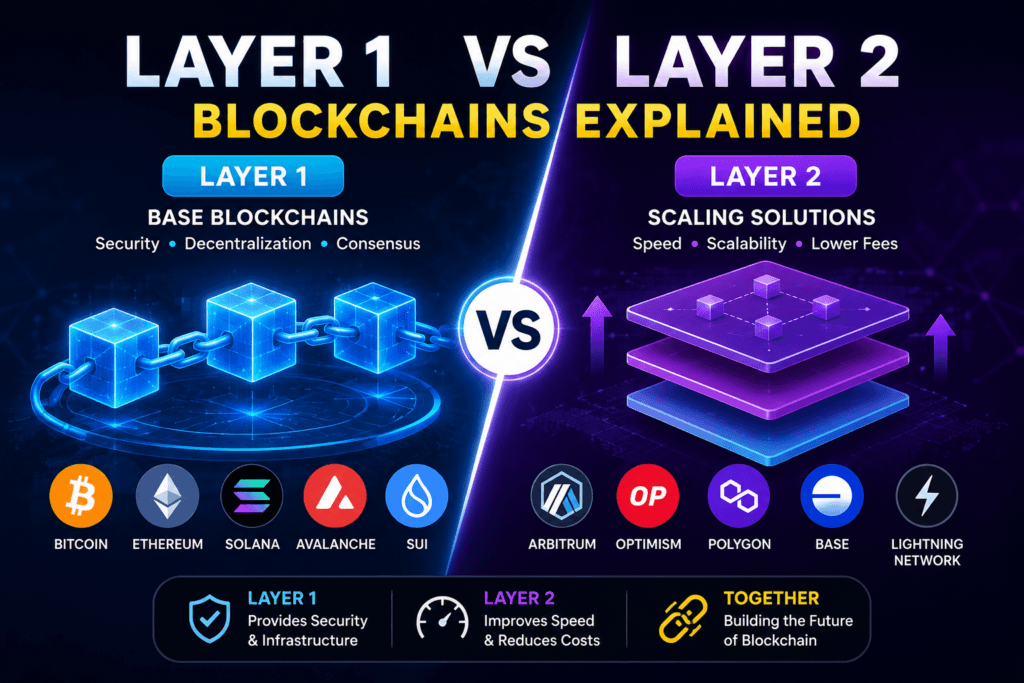
A Layer 1 blockchain is the main or base blockchain network itself. It processes and records transactions directly on its own blockchain.
Examples of major Layer 1 blockchains include:
Bitcoin (BTC) Ethereum (ETH) Solana (SOL) Cardano (ADA) Avalanche (AVAX) Sui (SUI)
Layer 1 blockchains are responsible for:
Network security Consensus mechanisms Transaction validation Smart contract execution Blockchain infrastructure
What Is a Layer 2 Blockchain?
A Layer 2 blockchain is built on top of an existing Layer 1 blockchain.
Its goal is to improve:
Transaction speed Scalability Network efficiency Lower transaction costs
Instead of processing everything directly on the main blockchain, Layer 2 solutions handle some activity separately before finalizing transactions on the Layer 1 network. Also, layer 2 solutions became increasingly important as Ethereum gas fees and blockchain congestion continued rising during major crypto bull markets.
Popular Layer 2 solutions include:
Arbitrum Optimism Polygon Base Lightning Network
Why Blockchain Scalability Matters
 Why Blockchain Scalability Matters
As more users join crypto networks, blockchain congestion can increase rapidly.
This may lead to:
 Slower transactions High gas fees Poor user experience
For example: During major bull markets, Ethereum gas fees have sometimes become extremely expensive because of heavy network usage.
Scalability solutions help blockchains support:
More users Faster applications Lower costs Better performance
How Layer 1 Blockchains Improve Scalability
 How Layer 1 Blockchains Improve Scalability
Some Layer 1 projects try improving scalability directly at the base blockchain level.
Common approaches include:
Faster consensus mechanisms Larger block sizes Parallel transaction processing Improved blockchain architecture
For example:
Solana focuses heavily on speed and throughput Sui uses parallel transaction execution Avalanche focuses on high-performance subnet systems
The advantage of Layer 1 scaling is that improvements happen directly on the core blockchain. However, upgrading Layer 1 networks can be difficult and time-consuming.
How Layer 2 Solutions Improve Scalability
Layer 2 solutions reduce congestion by processing transactions away from the main blockchain. After transactions are processed:
 Final results are recorded on the Layer 1 blockchain.
This helps:
Reduce network load Increase transaction speed Lower fees Improve scalability
Ethereum Layer 2 networks help users avoid extremely high gas fees during periods of heavy activity.
Layer 1 vs Layer 2 Blockchains: Key Differences
 Layer 1 vs Layer 2 Blockchains: Key Differences
| Feature | Layer 1 | Layer 2 |
|---|---|---|
| Role | Base blockchain | Built on top of Layer 1 |
| Examples | Bitcoin, Ethereum, Solana | Arbitrum, Polygon, Optimism |
| Main Goal | Core infrastructure | Scalability improvement |
| Transaction Processing | On-chain | Off-chain or secondary processing |
| Security | Native blockchain security | Inherits security from Layer 1 |
| Fees | Can become expensive | Usually lower |
| Speed | Often slower during congestion | Usually faster |
Popular Layer 1 Blockchains
 Popular Layer 1 Blockchains
Bitcoin (BTC)
 Bitcoin (BTC)
The first and most decentralized cryptocurrency network.
Focused mainly on:
Security Decentralization Store of value
Ethereum (ETH)
 Ethereum (ETH)
The leading smart contract blockchain supporting:
DeFi NFTs Gaming Layer 2 ecosystems
Solana (SOL)
High transaction speeds Low fees Strong ecosystem growth
Sui (SUI)
 Sui (SUI)
A newer blockchain focused on:
Scalability Parallel execution Fast transaction processing
Popular Layer 2 Blockchain Solutions
 Popular Layer 2 Blockchain Solutions
Arbitrum
A major Ethereum Layer 2 network focused on scalability and lower fees.
Optimism
 Optimism
Designed to improve Ethereum transaction efficiency and support decentralized applications.
Polygon
One of the most widely used Ethereum scaling ecosystems.
Lightning Network
Lightning network is built on Bitcoin to improve payment speed and reduce transaction costs.
Why Layer 2 Networks Became So Popular
 Why Layer 2 Networks Became So Popular
Layer 2 adoption increased rapidly because users wanted:
Faster transactions Lower fees Better user experience
Without Layer 2 solutions, many blockchain networks could struggle handling global-scale adoption.
This is especially important for:
Gaming DeFi Micropayments NFT trading Social applications
Risks & Challenges
Security Risks
 Security Risks
Some Layer 2 systems may introduce additional complexity and technical risks.
Centralization Concerns
Some blockchain networks sacrifice decentralization for higher speed.
Ecosystem Fragmentation
Users may need to bridge assets between multiple chains and Layer 2 networks.
Technical Complexity
Beginners often find blockchain infrastructure difficult to fully understand.
Which Is Better: Layer 1 vs Layer 2 Blockchains?
There is no simple winner because both technologies serve different purposes.
Layer 1 blockchains provide:
Security Decentralization Core infrastructure
Layer 2 solutions provide:
Scalability Faster transactions Lower fees Better usability
In reality: Both Layer 1 and Layer 2 technologies will likely continue working together as crypto adoption grows.
Why Layer 1 & Layer 2 Matter
Understanding blockchain layers helps investors better understand:
Crypto scalability Blockchain infrastructure Ethereum ecosystem growth Network congestion Future crypto adoption trends
These technologies are becoming increasingly important as blockchain applications continue expanding worldwide.
Final Thoughts
Layer 1 and Layer 2 blockchains both play critical roles in the future of crypto. Layer 1 networks provide the foundation for blockchain security and decentralization while Layer 2 solutions help improve scalability and efficiency. As crypto adoption grows, scalable blockchain infrastructure will become even more important for:
Payments Gaming DeFi NFTs Global financial systems
Understanding the difference between Layer 1 and Layer 2 can help beginners better understand how modern blockchain ecosystems continue evolving.
Key Takeaways
- Layer 1 blockchains are the main blockchain networks like Bitcoin, Ethereum, and Solana.
- Layer 2 solutions are built on top of Layer 1 networks to improve scalability and reduce transaction costs.
- Popular Layer 2 networks include Arbitrum, Optimism, Polygon, and Lightning Network.
- Layer 1 focuses on blockchain security and infrastructure while Layer 2 focuses on speed and efficiency.
- Both Layer 1 and Layer 2 technologies are important for the future growth of blockchain adoption.
Frequently Asked Questions (FAQ)
1. What is a Layer 1 blockchain?
A Layer 1 blockchain is the main blockchain network that processes and validates transactions directly on its own infrastructure.
2. What is a Layer 2 blockchain?
A Layer 2 solution is built on top of a Layer 1 blockchain to improve scalability, increase transaction speed, and reduce fees.
3. What are examples of Layer 1 blockchains?
Popular Layer 1 blockchains include Bitcoin, Ethereum, Solana, Cardano, Avalanche, and Sui.
4. What are examples of Layer 2 networks?
Popular Layer 2 networks include Arbitrum, Optimism, Polygon, Base, and the Bitcoin Lightning Network.
5. Why are Layer 2 solutions important?
Layer 2 solutions help reduce blockchain congestion, improve transaction speed, lower fees, and support large-scale crypto adoption.